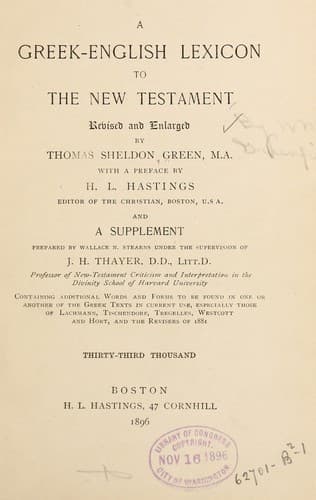
A Greek-English Lexicon to the New TestamentGreenfield, William
Religion
A Greek-English Lexicon to the New Testament
Greenfield, William
Bible. New Testament -- Dictionaries -- English; Greek language, Biblical -- Dictionaries -- English
to feel dread of a thing; to venerate, adore, worship, Ro. 1.25:
whence
Σέβασμα, ατος, τό,
an object of religious veneration and worship,
Ac. 17.23. 2 Th. 2.4. L.G.
Σεβαστός, ή, όν,
pr. venerable, august; ὁ Σεβαστός, i.q. Lat. Augustus, Ac. 25.21, 25;
Augustan, or, Sebastan, named from the city Sebaste, Ac. 27.1.
Σέβομαι,
to stand in awe; to venerate, reverence, worship, adore,
Mat. 15.9. Ac. 19.27; et al.;
part. σεβόμενος, η, ον, worshipping, devout, pious,
a term applied to proselytes to Judaism, Ac. 13.43, et al.
Σειρά, ᾶς, ἡ,
a cord, rope, bank; in N.T., a chain, 2 Pe. 2.4.
Σεισμός, οῦ, ὁ,
pr. a shaking, agitation, concussion; an earthquake,
Mat. 24.7; 27.54, et al.; a tempest, Mat. 8.24:
from
Σείω,
f. σείσω, a.l. ἔσεισα,
to shake, agitate, He. 12.26. Re. 6.13;
pass. to quake, Mat. 27.51; 28.4;
met. to put in commotion, agitate, Mat. 21.10.
Σελήνη, ης, ἡ,
the moon, Mat. 24.29. Mar. 13.24, et al.:
whence
Σεληνιάζομαι,
f. άσομαι,
to be lunatic, Mat. 4.24; 17.15. L.G.
Σεμίδᾱλις, εως, ἡ,
the finest flour, R. 18.13.
Σεμνός, ή, όν, (σέβομαι)
august, venerable; honourable, reputable, Phi. 4.8;
grave, serious, dignified, 1 Ti. 3.8, 11. Tit. 2.2:
whence
Σεμνότης, τητος, ἡ,
pr. majesty; gravity, dignity, dignified seriousness,
2 Ti. 2.2; 3.4.
Σημαίνω, (σῆμα, a sign, mark)
f. ανῶ, a.1. ἐσήμηνα & ἐσήμᾱνα,
to indicate by a sign, to signal; to indicate, intimate, Jno. 12.33;
to make known, communicate, Ac. 11.28. Re. 1.1;
to specify, Ac. 25.27.
Σημεῖον, ου, τό (fr. same)
a sign, a mark, token, by which any thing is known or
distinguished, Mat. 16.3; 24.3. 2 Th. 3.17;
a token, pledge, assurance, Lu. 2.12;
a proof, evidence, convincing token,
Mat. 12.38; 16.1. Jno. 2.18; in N.T.,
a sign, wonder, remarkable event, wonderful appearance,
extraordinary phenomenon, 1 Co. 14.22. Re. 12.1, 3; 15.1;
a portent, prodigy, Mat. 24.30. Ac. 2.19;
a wonderful work, miraculous operation, miracle,
Mat. 24.24. Mar. 16.17, 20;
meton. a sign, a signal character, Lu. 2.34:
whence
Σημειόω, ῶ,
f. ώσω,
to mark, inscribe marks upon;
mid. to mark for one's self, note, 2 Th. 3.14.
Σήμερον,
adv. to-day, this day, Mat. 6.11, 30; 16.3; 21.28;
now, at present, He. 13.8. 2 Co. 31.15;
ἡ σήμερον, sc. ἡμέρα, sometimes expresed, this day,
the present day, Ac. 20.26;
ἕως v. ἄχρι τῆς σήμερον, until this day, until our times,
Mat. 11.23; 27.8, et al. freq.
Σήπω,
to cause to putrify, make rotten; mid. σήπομαι,
p. 2. σεσηπα, to putrify, rot, be corrupted or
rotten, Ja. 5.2.
Σηρικός, ή, όν, (σήρ, a silkworm)
silk, of silk, silken;
τὸ σηρικόν, silken stuff, silk, Re. 18.12. L.G.
Σής, σεός & σητός, ὁ,
a moth, Mat. 6.19, 20. Lu. 12.33.
Σητόβρωτος, ου, ὁ, ἡ, τό, -ον, (σής & βιβρώσκω)
moth-eaten, Ja. 5.2. S.
Σθενόω, ῶ, (σθένος, strength)
f. ώσω, a.1. ἐσθένωσα,
to strengthen, impart strength, 1 Pe. 5.10. N.T.
Σιᾱγών, όνος, ἡ,
Public-domain text, read in full here on John Shaqi.
Reviews
Reviews
No reviews yet
Be the first to share your thoughts on this work.
Elsewhere in the archive
Join the Discussion
Join the discussion
Sign in to leave a comment or review.
Sign InorCreate an account