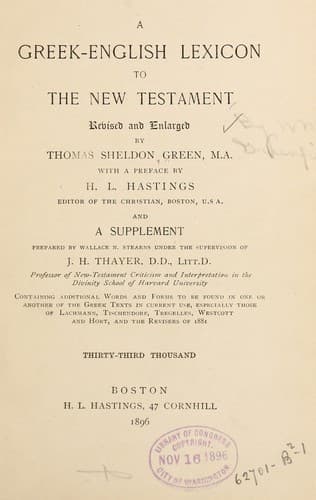
A Greek-English Lexicon to the New TestamentGreenfield, William
Religion
A Greek-English Lexicon to the New Testament
Greenfield, William
Bible. New Testament -- Dictionaries -- English; Greek language, Biblical -- Dictionaries -- English
the jaw-bone; in N.T., the cheek, Mat. 5.39. Lu. 6.29.
Σιγάω, ῶ,
f. ήσω, p. pass. σεσίγημαι,
to be silent, keep silence, Lu. 9.36; 20.26, et al.;
trans. to keep in silence, not to reveal, to conceal;
pass. to be concealed, not to be revealed, Ro. 16.25:
from
Σῑγή, ῆς, ἡ,
silence, Ac. 21.40. Re. 8.1.
Σιδήρεος, οῦς, εα, ᾶ, εον, οῦν,
made of iron, Ac. 12.10. Re. 2.27; 9.9; 12.5; 19.15:
from
Σίδηρος, ου, ὁ,
iron, Re. 18.12.
Σιδώνιος, ου, ὁ,
a Sidonian, an inhabitant of Σιδών, Sidon, Ac. 12.20.
Σικάριος, ου, ὁ, (Lat. sicarius, fr. sica, a dagger, poniard)
an assassin, bandit, robber, Ac. 21.38.
Σίκερα, τό, indec.(Heb. שכר)
strong or inebriating drink, Lu. 1.15. S.
Σιμικίνθιον, ου, τό,
(Lat. semicinctium, fr. semi, half, & cingo, to grid)
an apron, Ac. 19.12.
Σίνᾱπι, εως, τό,
mustard; in N.T., probably the shrub Khardal
(Salvadora Persica, L.), the fruit of which possesses
the pungency of mustard, Mat. 13.31; 17.20, et al.
Σινδών, όνος, ἡ,
sindon, pr. fine Indian cloth; fine linen; in N.T.,
a linen garment, an upper garment or wrapper of fine linen,
worn in summer by night, and used to envelope dead bodies,
Mat. 27.59. Mar. 14.51, 52; 15.46. Lu. 23.53.
Σινιάζω, (σινίον, a sieve)
f. άσω,
to sift; met. to sift by trials and temptation,
Lu. 22.31. L.G.
Σιτευτός, ή, όν, (σιτεύω, to feed or fatten, σῖτος)
fed, fatted, Lu. 15.23, 27, 30.
Σιτίον, ου, τό, (σῖτος)
provision of corn, food, v.r. Ac. 7.12.
Σιτιστός, ή, όν, (σιτίζω, to fatten, fr. σῖτος)
fatted, a fatling, Mat. 22.4.
Σιτομέτριον, ου, τό, (σῖτος & μετρέω)
a certain measure of grain distributed for food at set times
to the slaves of a family, a ration, Lu. 12.42. L.G.
Σῖτος, ου, ὁ,
corn, grain, wheat, Mat. 3.12; 13.25, 29, 30. Mar. 4.28, et. al.;
pl. σῖτα, bread, food, Ac. 7.12.
Σιωπάω, ῶ,
f. ήσω, a.1. ἐσιώπησα,
to be silent, keep silence, hold one's peace,
Mat. 20.31; 26.63, et al.; σιωπῶν, silent, dumb, Lu. 1.20;
met. to be silent, still, hushed, calm, as the sea, Mar. 4.39.
Σκανδαλίζω,
f. ίσω, a.1. ἐσκανδάλισα, a.1. pass. ἐσκανδαλίσθην,
pr. to cause to stumble; met. to offend, vex, Mat. 17.27;
to offend, shock, excite feelings of repugnance, Jno. 6.61. 1 Co. 8.13;
pass. to be offended, shocked, pained,
Mat. 15.12. Ro. 14.21. 2 Co. 11.29;
σκανδαλίζεσθαι ἔν τινι, to be affected with scruples or
repugnance towards any one as respects his claims or pretensions,
Mat. 11.6; 13.57, et al.; met.to cause to stumble morally,
to cause to falter, or err, Mat. 5.29; 18.6, et al.;
pass. to falter, fall away, Mat. 13.21, et al.: (S.)
from
Σκάνδᾰλον, ου, τό, (a later equivalent to σκανδάληθρον)
pr. a trap-spring; also genr. a stumbling-block,
any thing against which one stumbles, an impediment;
met. a cause of ruin, destruction, misery, &c. R. 9.33; 11.9;
a cause or occasion of sinning, Mat. 18.7, ter. Lu. 17.1;
scandal, offence, cause of indignation, 1 Co. 1.23. Ga. 5.11.
Σκάπτω,
f.
Public-domain text, read in full here on John Shaqi.
Reviews
Reviews
No reviews yet
Be the first to share your thoughts on this work.
Elsewhere in the archive
Join the Discussion
Join the discussion
Sign in to leave a comment or review.
Sign InorCreate an account