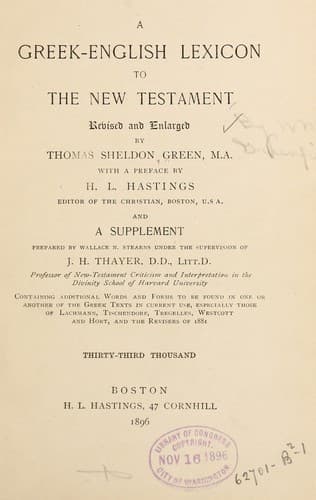
A Greek-English Lexicon to the New Testament — John Shaqi
A Greek-English Lexicon to the New TestamentGreenfield, William
Religion
A Greek-English Lexicon to the New Testament
Greenfield, William
Bible. New Testament -- Dictionaries -- English; Greek language, Biblical -- Dictionaries -- English
which cannot be explored, inscrutable, incomprehensible,
Ro. 11.33. Ep. 3.8. S.
Ἀνεπαίσχυντος, ου, ὁ, ἡ, (ἀ & ἐπαισχύνομαι)
without cause of shame, irreproachable, 2 Ti. 2.15. N.T.
Ἀνεπίληπτος, ου, ὁ, ἡ, (ἀ & ἐπιλαμβάνω)
pr. not to be laid hold of, met. irreprehensible, unblameable,
1 Ti. 3.2; 5.7; 6.14.
Ἀνέρχομαι, (ἀνά & ἔρχομαι)
f. ελεύσομαι, a.2. ἀνῆλθον,
to ascend, go up, Jno. 6.3. Gal. 1.17, 18.
Ἄνεσις, εως, ἡ, (ἀνίημι)
pr. the relaxing of any state of constraint; relaxation
of rigour of confinement, Ac. 24.23; met. ease, rest, peace,
tranquillity, 2 Co. 2.12; 7.5; 8.13. 2 Thes. 1.7.
Ἀνετάζω,
f. άσω,
to examine throughly; to examine by torture, Ac. 22.24, 29. S.
Ἄνευ,
without, Mat. 10.29. 1 Pe. 3.1; 4.9.
Ἀνεύθετος, ου, ὁ, ἡ, (ἀ & εὔθετος)
not commodious, inconvenient, Ac. 27.12. N.T.
Ἀνευρίσκω, (ἀνά & εὑρίσκω)
f. ρήσω,
to find by diligent search, Lu. 2.16. Ac. 21.4.
Ἀνέχομαι, (ἀνά & ἔχω)
f. έξομαι, imperf. ἀνειχόμην, ἠνειχόμην, ἠνεσχόμην,
to endure, bear with; to suffer, admit, permit.
Ἀνεψιός, οῦ, ὁ,
a nephew, Col. 4.10.
Ἄνηθον, ου, τό,
anethum, dill, an aromatic plant, Mat. 23.23.
Ἀνήκω, (ἀνά & ἥκω)
to come up to, to pertain to; ἀνήκει, impers. it is fit,
proper, becoming, Col. 3.18. Ep. 5.4. Phile. 8.
Ἀνήμερος, ου, ὁ, ἡ, (ἀ & ἥμερος, gentle, mild,)
ungentile, fierce, ferocious, 2 Ti. 3.3.
Ἀνήρ, ἀνδρός, ὁ,
a male person of full age and stature, as opposed to a
child or female; a husband; a man, homo, human being;
a certain man; some one; that man, he, ille; used also
pleonastically with other nouns and adjectives.
Ἀνθίστημι, (ἀντί & ἵστημι)
f. ἀντιστήσω, a.2. ἀντέστην, perf. ἀνθέστηκα,
to oppose, resist, stand out against.
Ἀνθομολογέομαι, οῦμαι, (ἀντί & ὁμολογέω)
pr. to come to an agreement; hence, to confess openly
what is due; to confess, give thanks, praise, celebrate,
extol, Lu. 2.38.
Ἄνθος, εος, ους, τό,
a flower, Ja. 1.10, 11. 1 Pe. 1.24. bis.
Ἀνθρακιά, ᾶς, ἡ
a mass or heap of live coals, Jno. 18.18; 21.9:
from
Ἄνθραξ, ᾰκος, ὁ
a coal, burning coal, Ro. 12.20.
Ἀνθρωπάρεσκος, ου, ὁ, ἡ, (ἄνθρωπος & ἀρέσκω)
desirous of pleasing men, Ep. 6.6. Col. 3.22. S.
Ἀνθρώπινος, η, ον, (ἄνθρωπος)
human, belonging to man, 1 Co. 2.4, 13; 4.3; 10.13.
Ja. 3.7. 1 Pe 2.13; suited to man, Ro. 6.19.
Ἀνθρωποκτόνος, ου, ὁ, ἡ, (ἄνθρωπος & κτείνω)
a homicide, murderer, Jno. 8.44. 1 Jno. 3.15.
Ἄνθρωπος, ου, ὁ, ἡ,
a human being; an individual; used also pleonastically
with other words; met.a spiritual frame or character,
1 Pe. 3.4.
Ἀνθυπατεύω,
f. εύσω,
to be proconsul, Ac. 18.12:
from
Ἀνθύπᾰτος, ου, ὁ, (ἀντί & ὕπατος, a consul)
a proconsul, Ac. 13.7, 8, 12; 19.38. L.G.
Ἀνίημι, (ἀνά & ἵημι)
f. ἀνήσω, a.2. ἀνῆν, s. ἀνῶ, a.1. pass. ἀνέθην,
to loose, slacken, Ac. 27.40; to unbind, unfasten,
Ac. 16.26; to omit or lessen, Ep. 6.9; to leave or
neglect, He. 13.5.
Ἀνίλεως, ω, ὁ, ἡ, (ἀ & ἵλεως)
Public-domain text, read in full here on John Shaqi.
Reviews
Reviews
No reviews yet
Be the first to share your thoughts on this work.
Join the Discussion
Join the discussion
Sign in to leave a comment or review.
Sign InorCreate an account