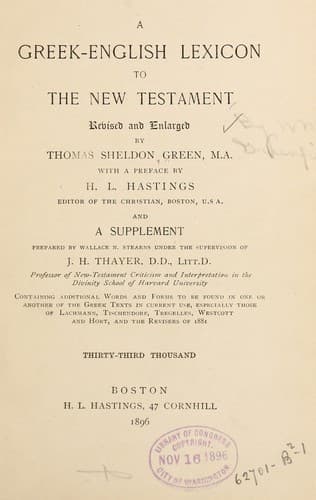
A Greek-English Lexicon to the New TestamentGreenfield, William
Religion
A Greek-English Lexicon to the New Testament
Greenfield, William
Bible. New Testament -- Dictionaries -- English; Greek language, Biblical -- Dictionaries -- English
so great, so much, Mat. 8.10; 15.33;
so long, of time, Jno. 14.9;
pl. so many, Mat. 15.33, et al.
Τότε,
adv. of time, then, at that time, Mat. 2.17; 3.5; 11.20;
then, thereupon, Mat. 12.29; 13.26; 25.31;
ἀπὸ τότε, from that time, Mat. 4.17; 16.21;
ὁ τότε, which then was, 2 Pe. 3.6.
Τοὐναντίον, (by crasis for τὸ ἐναντίον)
that which is opposite; as an adv. on the contrary,
on the other hand, 2 Co. 2.7. Ga. 2.7. 1 Pe. 3.9.
Τοὔνομα, (by crasis for τὸ ὄνομα)
the name; in the acc. by name, Mat. 27.57.
Τουτέστι, (by crasis for τοῦτ᾿ ἔστι)
that is, which signifies, which implies,
Ac. 1.19; 19.4, et al.
Τράγος, ου, ὁ,
a he-goat, He. 9.12, 13, 19; 10.4.
Τράπεζα, ης, ἡ, (τετράς, four, & πέζα, a foot)
a table, an eating-table, Mat. 15.27. Mar. 7.28. He. 9.2;
by impl. a meal, feast, Ro. 11.9. 1 Co. 10.21;
a table or counter of a money-changer, Mat. 21.12;
a bank, Lu. 19.23;
by impl., pl. money matters, Ac. 6.2:
whence
Τραπεζίτης, ου, ὁ,
a money-charger, broker, banker, who exchanges or
loans money for a premium, Mat. 25.27. (ῑ.)
Τραῦμα, ατος, τό, (τιτρώσκω)
a wound, Lu. 10.34:
whence
Τραυματίζω,
f. ίσω, a.1. ἐτραυμάτισα,
to wound, Lu. 20.12. Ac. 19.16.
Τραχηλίζω,
f. ίσω, p. pass. τετραχήλισμαι,
pr. to gripe the neck; to bend the neck back so as
to make bare or expose the throat, as in slaughtering
animals, &c.; met. to lay bare the view, He. 4.13:
from
Τράχηλος, ου, ὁ,
the neck, Mat. 18.6, et al.;
ἐπιθεῖναι ζυγὸν ἐπὶ τὸν τράχηλον,
to put a yoke upon the neck of any one,
met. to bind to a burdensome observance,
Ac. 15.10; ὑποτιθέναι τὸν τράχηλον,
to lay down one's neck under the axe of the executioner,
to imperil one's life, Ro. 16.4.
Τρᾱχύς, εῖα, ύ,
rough, rugged, uneven, Lu. 3.5;
εἰς τραχεῖς τόπους, on a rocky shore, Ac. 27.29.
Τρεῖς, οἱ, αἱ, τά, τρία,
three, Mat. 12.40, et al.
Τρέμω, (τρέω, idem)
to tremble, be agitated from fear,
Mar. 5.33. Lu. 8.47. Ac. 9.6;
by impl. to fear, be afraid, 2 Pe. 2.10.
Τρέφω,
f. θρέψω, a.1. ἔθρεψα, p. pass. τέθραμμαι,
to thicken; to nourish; to feed,
support, cherish, provide for, Mat. 6.26; 25.37, et al.;
to bring up, rear, educate, Lu. 4.16;
to gorge, to pamper, Ja. 5.5.
Τρέχω,
f. θρέξομαι, & δραμοῦμαι, a.2. ἔδραμον,
to run, Mat. 27.48; 28.8, et al.;
to run a race, 1 Co. 9.24; met. 1 Co. 9.24, 26. He. 12.1;
in N.T., to run a certain course of conduct, Ga. 5.7;
to run a course of exertion, Ro. 9.16. Ga. 2.2. Phi. 2.16;
to run, to progress freely, to advance rapidly, 2 Th. 3.1.
Τριάκοντα, οἱ, αἱ, τά, (τρεῖς)
thirdy, Mat. 13.8, 23, et al.
Τριακόσιοι, αι, α, (τρεῖς)
three hundred, Mar. 14.5. Jno. 12.5.
Τρίβολος, ου, ὁ, (τρεῖς & βέλος)
pr. three-pronged;
as subst. a caltrop; a plant, land-caltrop, a thorn,
Mat. 7.16. He. 6.8.
Τρίβος, ου, ἡ, (τρίβω, to run, wear)
a beaten track; a road, highway,
Mat. 3.3. Mar. 1.3. Lu. 3.4.
Τριετία, ας, ἡ, (τρεῖς & ἔτος)
the space of three years, Ac. 20.31.
Public-domain text, read in full here on John Shaqi.
Reviews
Reviews
No reviews yet
Be the first to share your thoughts on this work.
Elsewhere in the archive
Join the Discussion
Join the discussion
Sign in to leave a comment or review.
Sign InorCreate an account