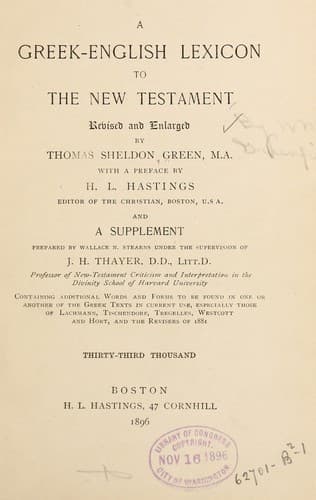
A Greek-English Lexicon to the New TestamentGreenfield, William
Religion
A Greek-English Lexicon to the New Testament
Greenfield, William
Bible. New Testament -- Dictionaries -- English; Greek language, Biblical -- Dictionaries -- English
Ac. 1.13; 9.37, 39; 20.8.
Ὑπέχω, (ὑπό & ἔχω)
f. ὑφέξω,
pr. to hold under; to render, undergo, suffer. Jude 7.
Ὑπήκοος, οῦ, ὁ, ἡ, (ὑπακούω)
giving ear; obedient, submissive, Ac. 7.39. 2 Co. 2.9. Ph. 2.8.
Ὑπηρετέω, ῶ,
f. ήσω, a.1. ὑπηρέτησα,
to subserve, Ac. 13.36; to relieve, supply, Ac. 20.34;
to render kind offices, Ac. 24.23:
from
Ὑπηρέτης, ου, ὁ, (ὑπό & ἐρέτης, a rower)
pr. an under-rower, a rower, one of a ship's crew;
a minister, attendant, servant; an attendant on a magistrate,
a lictor, apparitor, officer, Mat. 5.25;
an attendant or officer of the Sanhedrin, Mat. 26.58;
an attendant, or servant of a synagogue, Lu. 4.20;
a minister, attendant, assistant in any work,
Lu. 1.2. Jno. 18.36, et al.
Ὕπνος, ου, ὁ,
sleep, Mat. 1.24, et al.;
met. spiritual sleep, religious slumber, Rο. 13.11.
Ὑπό,
prep., with a genitive,
pr. under: hence used to express influence, causation, agency; by,
Mat. 1.22, et al. freq.; by the agency of, at the hands of,
2 Co. 11.24. He. 12.3;
with an accusative, under, with the idea of motion associated,
Mat. 5.15, et al.; under, Jno. 1.49. 1 Co. 10.1;
under subjection to, Ro. 6.14. 1 Ti. 6.1, et al.;
of time, at about, Ac. 5.21.
Ὑποβάλλω, (ὑπό & βάλλω)
f. βαλπῶ, a.2. ὑπέβαλον,
to cast under; met. to suggest, instigate; to suborn, Ac. 6.11.
Ὑπογραμμός, οῦ, ὁ, (ὑπογράφω)
pr. a copy to write after;
met. an example for imitation, pattern, 1 Pe. 2.21. L.G.
Ὑπόδειγμα, ατος, τό,
a token, intimation; an example,
proposed for imitation or admonition,
Jno. 13.15. He. 4.11. Ja. 5.10. 2 Pe. 2.6;
a copy, He. 8.5; 9.23:
from
Ὑποδείκνυμι, (ὑπό & δείκνυμι)
to indicate, Ac. 20.35; to intimate, suggest,
Mat. 3.7. Lu. 3.7; 6.47; 12.5. Ac. 9.16.
Ὑποδέχομαι, (ὑπό & δέχομαι)
f. ξομαι, p. ὑπεδέδεγμαι,
to give reception to; to receive as a guest,
entertain, Lu. 10.38; 19.6. Ac. 17.7. Ja. 2.25.
Ὑποδέω, ῶ (ὑπό & δέω)
f. ήσω, p. pass. ὑποδέδεμαι,
to bind under; mid. to bind under one's self,
put on one's own feet, Ac. 12.8; to shoe, Ep. 6.15;
pass. to be shod, Mar. 6.9:
whence
Ὑπόδημα, ατος, τό,
any thing bound under; a sandal, Mat. 3.11; 10.10, et al.
Ὑπόδῐκος, ου, ὁ, ἡ, (ὑπό & δίκη)
under a legal process; also, under a judicial sentence;
under verdict to an opposed party in a suit, liable to penalty,
convict, Ro. 3.19.
Ὑποζύγιον, ίου, τό,
(pr. neut. of ὑποζύγιος), under a yoke, fr. ὑπό & ζυγόν)
an animal subject to the yoke, a beast of draught or burden;
in N.T., spc. an ass, Mat. 21.5. 2 Pe. 2.16.
Ὑποζώννυμι, (ὑπό & ζώννυμι)
f. ζώσω,
to gird under, of persons; to undergird a ship with cables,
chains, &c. Ac. 27.17.
Ὑποκάτω, (ὑπό & κάτω)
adv. under, beneath, underneath, Mar. 6.11; 7.28, et al.;
met. He. 2.8. (ᾰ)
Ὑποκρίνομαι, (ὑπό & κρίνω)
f. οῦμαι,
to answer, respond; to act a part upon the stage; hence,
to assume a counterfeit character; to pretend, feign, Lu. 20.20:
whence
Ὑπόκρῐσις, εως, ἡ,
Public-domain text, read in full here on John Shaqi.
Reviews
Reviews
No reviews yet
Be the first to share your thoughts on this work.
Elsewhere in the archive
Join the Discussion
Join the discussion
Sign in to leave a comment or review.
Sign InorCreate an account