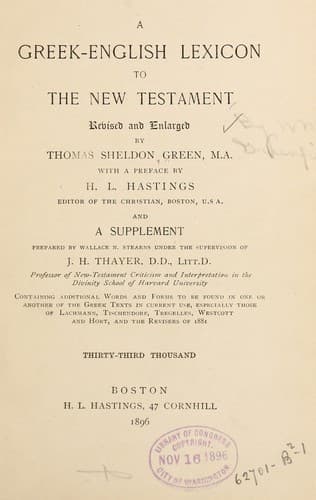
A Greek-English Lexicon to the New TestamentGreenfield, William
Religion
A Greek-English Lexicon to the New Testament
Greenfield, William
Bible. New Testament -- Dictionaries -- English; Greek language, Biblical -- Dictionaries -- English
a response, answer; histrionic personification, acting;
hypocrisy, simulation, Mat. 23.28. Mar. 12.15, et al.
Ὑποκρῐτής, οῦ, ὁ,
the giver of an answer or response; a stage-player, actor;
in N.T., a moral or religious counterfeit, a hypocrite,
Mat. 6.2, 5.16; 7.5, et al.
Ὑπολαμβάνω, (ὑπό & λαμβάνω)
f. λήψομαι, a.2. ὑπέλαβον,
to take up, by placing one's self underneath what is taken up;
to catch away, withdraw, Ac. 1.9; to take up discourse by continuation;
hence, to answer, Lu. 10.30;
to take up a notion, to think, suppose, Lu. 7.43. Ac. 2.15.
Ὑπολείπω, (ὑπό & λείπω)
f. ψω,
to leave remaining, leave behind; pass. to be left surviving, Ro. 11.3.
Ὑπολήνιον, ου, τό, (ὑπό & ληνός)
a vat, placed under the press, ληνός,
to receive the juice, Mar. 12.1. S.
Ὑπολιμπάνω, (ὑπό & λιμπάνω, to leave)
equivalent to ὑπολείπω, to leave behind, 1 Pe. 2.21.
Ὑπομένω, (ὑπό & μένω)
f. νῶ,
intrans. to remain or stay behind, when others have departed, Lu. 2.43;
trans. to bear up under, endure, suffer patiently, 1 Co. 13.7. He. 10.32;
absol. to continue firm, hold out, remain constant, persevere,
Mat. 10.22; 24.13, et al.
Ὑπομιμνήσκω, (ὑπό & μιμνήσκω)
f. ὑπομνήσω,
to put in mind, remind, Jno. 14.26. Tit. 3.1. 2 Pe. 1.12. Jude 5;
to suggest recollection of, remind others of, 2 Ti. 2.14. 3 Jno. 10;
mid. ὑπομιμνήσκομαι, a.1. ὑπεμνήσθην,
to call to mind, recollect, remember, Lu. 22.61:
whence
Ὑπόμνησις, εως, ἡ,
a putting in mind, act of reminding, 2 Pe. 1.13; 3.1;
remembrance, recollection, 2 Ti. 1.5.
Ὑπομονή, ῃς, ἡ, (ὑπομένω)
patient endurance, 2 Co. 12.12. Col. 1.11. et al.;
patient awaiting, Lu. 21.19;
a patient frame of mind, patience,
Ro. 5.3, 4; 15.4, 5. Ja. 1.3, et al.;
perseverance, Ro. 2.7;
ἐν ὑπομονῇ & δι' ὑπομονῆς, constantly, perseveringly,
Lu. 8.15. Ro. 8.25. He. 12.1;
an enduring of affliction, &c., the act of suffering, undergoing, &c.,
2 Co. 1.6; 6.4.
Ὑπονοέω, ῶ, (ὑπό & νοέω)
f. ήσω,
to suspect; to suppose, deem, Ac. 13.25; 25.18; 27.27:
whence
Ὑπόνοια, ας, ἡ,
suspicion, surmise, 1 Ti. 6.4.
Ὑποπλέω, (ὑπό & πλέω)
f. εύσομαι,
to sail under; to sail under the lee, or,
to the south of, an island, &c., Ac. 27.4, 7. L.G.
Ὑποπνέω, (ὑπό & πνέω)
f. εύσω,
to blow gently, as the wind, Ac. 27.13. N.T.
Ὑποπόδιον, ίου, τό, (ὑπό & πούς)
a footstool, Mat. 5.35. Ja. 2.3, et al. L.G.
Ὑπόστᾰσις, εως, ἡ (ὑφίσταμαι, to stand under, ὑπό & ἵστημι)
pr. a being set under; a substructure, basis, bottom;
subsistence, essence, He. 1.3;
an assumption of a character, 2 Co. 11.17;
a pledged assumption, vouching, 2 Co. 9.4;
a professed engagement, profession, He. 3.14;
an assured impression, a realising, He. 11.1.
Ὑποστέλλω, (ὑπό & στέλλω)
f. στελῶ, a.1. ὑπέστειλα,
pr. to let down, to stow away; to draw back, withdraw, Ga. 2.12;
mid. to shrink back, quail, recoil, He. 10.38;
to keep back, suppress, conceal, Ac. 20.20, 27:
whence
Ὑποστολή, ῆς, ἡ,
Public-domain text, read in full here on John Shaqi.
Reviews
Reviews
No reviews yet
Be the first to share your thoughts on this work.
Elsewhere in the archive
Join the Discussion
Join the discussion
Sign in to leave a comment or review.
Sign InorCreate an account