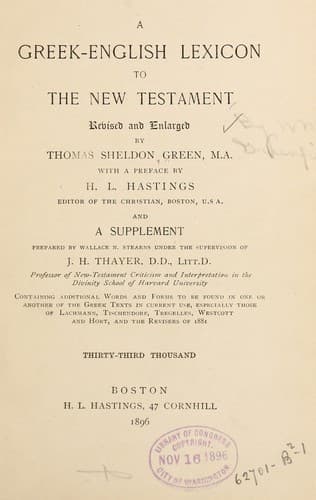
A Greek-English Lexicon to the New TestamentGreenfield, William
Religion
A Greek-English Lexicon to the New Testament
Greenfield, William
Bible. New Testament -- Dictionaries -- English; Greek language, Biblical -- Dictionaries -- English
a shrinking back, He. 10.39. L.G.
Ὑποστρέφω, (ὑπό & στρέφω)
f. ψω,
to turn back, return,
Mar. 14.40. Lu. 1.56; 2.39, 43, 45, et al.
Ὑποστρώννυμι, v. ννύω, (ὑπό & στρώννυμι)
f. στρώσω,
to strow under, spread underneath, Lu. 19.36.
Ὑποτᾰγή, ῆς, ή,
subordination, 1 Ti. 3.4;
submissiveness, 2 Co. 9.13. Ga. 2.5. 1 Ti. 2.11: (N.T.)
from
Ὑποτάσσω, v. ττω, (ὑπό & τάσσω)
f. ξω,
to place or arrange under;
to subordinate, 1 Co. 15.27;
to bring under influence, Ro. 8.20;
pass. to be subordinated, 1 Co. 14.32, et al.;
to be brought under a state of influence, Ro. 8.20;
mid. to submit one's self, render obedience,
be submissive, Lu. 2.51; 10.17, et al.
Ὑποτίθημι, (ὑπό & τίθημι)
f. ὑποθήσω,
to place under; to lay down the neck beneath the sword
of the executioner, to set on imminent risk, Ro. 16.4;
mid. to suggest, recommend to attention, 1 Ti. 4.6.
Ὑποτρέχω, (ὑπό & τρέχω)
a.2. ὑπέδρᾰμον,
to run under;
as a nautical term, to sail under the lee of, Ac. 27.16.
Ὑποτύπωσις, εως, ἡ, (ὑποτυπόω, to sketch, fr. ὑπό & τυπόω)
a sketch, delineation; form, formula, 2 Ti. 1.13;
a pattern, example, 1 Ti. 1.16.
Ὑποφέρω, (ὑπό & φέρω)
a.1. ὑπήνεγκα, a.2. ὑπήνεγκον,
to bear under; to bear up under, support, sustain, 1 Co. 10.13;
to endure patiently, 1 Pe. 2.19; to undergo, 2 Ti. 3.11.
Ὑποχωρέω, ῶ, (ὑπό & χωρέω)
f. ήσω,
to withdraw, retire, Lu. 5.16; 9.10.
Ὑπωπιάζω,
(ὑπώπιον, the part of the face below the eyes, fr. ὑπό & ὤψ)
pr. to strike one upon the parts beneath the eye;
to beat black and blue; hence, to discipline by hardship,
coerce, 1 Co. 9.27;
met. to weary by continual importunities, pester, Lu. 18.5.
Ὕς, ὑός, ὁ, ἡ,
a hog, swine, boar or sow, 2 Pe. 2.22.
Ὕσσωπος, ου, ὁ, ἡ, (Heb. אזוב)
hyssop, hyssopus officinalis of Linn.,
a low shrubby plant growing in the south of Europe and the East;
a bunch of hyssop, He. 9.19; a hyssop stalk, Jno. 19.29. L. G.
Ὑστερέω, ῶ, (ὕστερος)
f. ήσω, p. ὑστέρηκα, a.1. ὑστέρησα,
to be behind in place or time, to be in the rear;
to fall short of, be inferior to, 2 Co. 11.5; 12.11;
to fail of, fail to attain, He. 4.1;
to be in want of, lack, Lu. 22.35;
to be wanting, Mar. 10.21;
absol. to be defective, in default, Mat. 19.20. 1 Co. 12.24;
to run short, Jno. 2.3;
mid. to come short of a privilege or standard, to miss, Ro. 3.23;
absol. to come short, below standard, 1 Co. 1.7;
to come short of sufficiency, to be in need, want,
Lu. 15.14. 2 Co. 11.8. Phi. 4.12. He. 11.37;
to be a loser, suffer detriment, 1 Co. 8.8; in N.T.,
ὑστερεῖν ἀπό, to be backwards with respect to,
to slight, He. 12.15:
whence
Ὕστέρημα, ατος, τό,
a shortcoming, defect; personal shortcoming,
1 Co. 16.17. Phi. 2.30. Col. 1.24. 1 Th. 3.10;
want, need, poverty, penury,
Lu. 21.4. 2 Co. 8.13, 14, et al. S.
Ὑστέρησις, εως, ἡ,
want, need, Mar. 12.44. Phi. 4.11. N.T.
Ὕστερον
adv. after, afterwards, Mat. 4.2; 22.27, et al.:
pr. neut. of
Public-domain text, read in full here on John Shaqi.
Reviews
Reviews
No reviews yet
Be the first to share your thoughts on this work.
Elsewhere in the archive
Join the Discussion
Join the discussion
Sign in to leave a comment or review.
Sign InorCreate an account