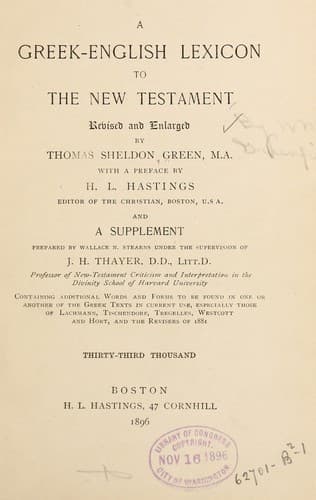
A Greek-English Lexicon to the New TestamentGreenfield, William
Religion
A Greek-English Lexicon to the New Testament
Greenfield, William
Bible. New Testament -- Dictionaries -- English; Greek language, Biblical -- Dictionaries -- English
fond of contention; contentious, disputatious, 1 Co. 11.16.
Φιλοξενία, ας, ἡ,
kindness to strangers, hospitality, Ro. 12.13. He. 12.2:
from
Φιλόξενος, ου, ὁ, ἡ, (φίλος & ξένος)
kind to strangers, hospitable, 1 Ti. 3.2. Tit. 1.8. 1 Pe. 4.9.
Φιλοπρωτεύω, (φίλος & πρωτεύω)
to love or desire to be first or chief,
affect preeminence, 3 Jno. 9. N.T.
Φίλος, ου, ὁ,
loved, dear; as subst. a friend, Lu. 7.6; 11.5, 6, 8, et al.;
a congenial associate, Mat. 11.19. Lu. 7.34. Ja. 4.4;
used as a word of courteous compellation, Lu. 14.10
Φιλοσοφία, ας, ἡ
pr. a love of science; systematic philosophy; in N.T.,
the philosophy of the Jewish gnosis, Col. 2.8:
from
Φιλόσοφος, ου, ὁ, (φίλος & σοφίας)
pr. a lover of science;
a systematic philosopher, Ac. 17.18.
Φιλόστοργος, ου, ὁ, ἡ, (φίλος & στοργή, natural affection)
tenderly affectionate, Ro. 12.10.
Φιλότεκνος, ου, ὁ, ἡ, (φίλος & τέκνον)
loving one's children, duly parental, Tit. 2.4.
Φιλοτιμέομαι, οῦμαι,
(φιλότιμος, studious of honour or distinction, fr. φίλος & τιμή)
f. ήσομαι,
pr. to be ambitious of honour;
by impl. to exert one's self to accomplish a thing,
use one's utmost efforts, endeavour earnestly,
Ro. 15.20. 2 Co. 5.9. 1 Th. 4.11.
Φιλοφρόνως,
adv. with kindly feeling or manner, courteously, Ac. 28.7:
from
Φιλόφρων, ονος, ὁ, ἡ, (φίλος & φρήν)
kindly-minded, benign, courteous, 1 Pe. 3.8.
Φῑμόω, ῶ, (φιμός, a muzzle)
f. ώσω, a.1. ἐφίμωσα, p. pass. πεφίμωμαι, a.1. ἐφιμώθην,
to muzzle, 1 Co. 9.9. 1 Ti. 5.18;
met. & by impl. to silence, put to silence;
pass. to be silent, speechless, Mat. 22.12, 34. Mar. 1.25, et al.;
trop. pass. to be hushed, as winds and waves, Mar. 4.39.
Φλογίζω,
f. ίσω,
to set a flame, kindle, inflame, Ja. 3.6, bis.:
from
Φλόξ, φλογός, ἡ, (φλέγω, to burn, blaze)
a flame, Lu. 16.24. Ac. 7.30, et al.
Φλυᾱρέω, ῶ
f. ήσω,
to talk folly; in N.T.,
trans. to prate about or against any one, 3 Jno. 10:
from
Φλύᾱρος, ου, ὁ, ἡ, (φλύω, to boil over, bubble; met. to babble)
a prater, tattler, 1 Ti. 5.13.
Φοβερός, ά, όν,
fearful; terrible, He. 10.27, 31; 12.21:
from
Φοβέω, ῶ (φόβος)
f. ήσω,
to terrify, frighten;
mid. a.1. ἐφοβήθην, f. φοβνθήσομαι,
to fear, dread, Mat. 10.26; 14.5, et. al.;
to fear reverentially, to reverence,
Mar. 6.20. Lu. 1.50. Ac. 10.2. Eph. 5.33. Re. 11.18, et al.;
to be afraid to do a thing, Mat. 2.22. Mar. 9.32, et al.;
to be reluctant, to scruple, Mat. 1.20;
to fear, be apprehensive, Ac. 27.17. 2 Co. 11.3; 12.20;
to be fearfully anxious, He. 4.1.
absol. to be fearful, afraid, alarmed,
Mat. 14.27; 17.6, 7. Mar. 16.8, et al.;
to be fearfully impressed, Ro. 11.20:
whence
Φόβητρον, ου, τό,
something which inspires terror;
terrific prodigy or portent, Lu. 21.11.
Φόβος, ου, ὁ, (φέβομαι, to be affrighted, to flee)
fear, terror, affright, Mat. 14.26. Lu. 1.12;
astonishment, amazement, Mat. 28.8. Mar. 4.41;
trembling solicitude, 1 Co. 2.3. 2 Co. 7.15;
Public-domain text, read in full here on John Shaqi.
Reviews
Reviews
No reviews yet
Be the first to share your thoughts on this work.
Elsewhere in the archive
Join the Discussion
Join the discussion
Sign in to leave a comment or review.
Sign InorCreate an account