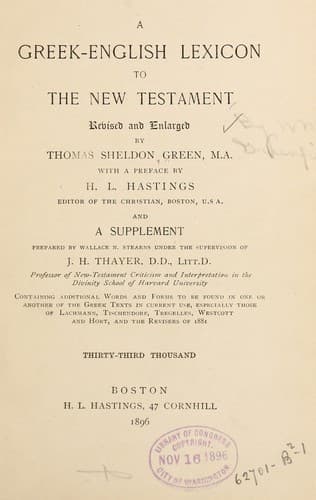
A Greek-English Lexicon to the New TestamentGreenfield, William
Religion
A Greek-English Lexicon to the New Testament
Greenfield, William
Bible. New Testament -- Dictionaries -- English; Greek language, Biblical -- Dictionaries -- English
meton. a terror, an object or cause of terror, Ro. 13.3;
reverential fear, awe, Ac. 9.31. Ro. 3.18;
respect, deference, Ro. 13.7. 1 Pe. 2.18.
Φοίνιξ, ῑκος, ὁ,
the palm-tree, the date-palm, phœnix dactylifera
of Linn., Jno. 12.13. Re. 7.9.
Φονεύς, έως, ὁ, (φόνος)
a homicide, murderer, Mat. 22.7. Ac. 3.14, et al.
Φονεύω,
f. εύσω, a.1. ἐφόνευσα,
to put to death, kill, slay, Mat. 23.31, 35, et al.;
absol. to commit murder, Mat. 5.21, et al.:
from
Φόνος, ου, ὁ,
a killing, slaughter, murder,
Mat. 15.19. Mar. 7.21; 15.7, et al.
Φορέω, ῶ,
f. ήσω & έσω, a.1. ἐφόρεσα,
to bear; to wear, Mat. 11.8. 1 Co. 15.49, et al.
Φόρον, ου, τό, (Lat. forum)
a forum, market-place;
Φόρον Ἀππίονυ Forum Appii, the name of a small town
on the Appian way, according to Antoninus, 43 Roman
miles from Rome, or about 40 English miles, Ac. 28.15.
Φόρος, ου, ὁ (φέρω)
tribute, tax, strictly such as is laid on dependent
and subject people, Lu. 20.22; 23.2. Ro. 13.6, 7.
Φορτίζω, (φόρτος, a load, φέρω)
f. ίσω, p. pass. πεφόρτισμαι,
to load, lade, burden; met. Mat. 11.28. Lu. 11.46.
Φορτίον, ου, τό,
a load, burden, as of a ship, freight, cargo,
v.r. Ac. 27.10; met. a burden of imposed precepts, &c.,
Mat. 11.30; 23.4. Lu. 11.46, bis;
of faults, sins, &c., Ga. 6.5:
from
Φόρτος, ου, ὁ, (φέρω)
a load, burden; freight, cargo, Ac. 27.10.
Φραγέλλιον, ίου, τό, (Lat. flagellum)
a whip, scourge, Jno. 2.15: (N.T.)
whence
Φραγελλόω, ῶ,
f. ώσω,
to scourge, Mat. 27.26. Mar. 15.15. N.T.
Φραγμός, οῦ, ὁ, (φράσσω)
a fence, hedge; a hedgeside path,
Mat. 21.33. Mar. 12.1. Lu. 14.23;
met. a parting fence, Ep. 2.14.
Φράζω,
f. άσω, a.1. ἔφρασα,
pr. to propound in distinct terms, to tell; in N.T.,
to explain, interpret, expound, Mat. 13.36; 15.15.
Φράσσω, v. ττω,
f. ξω, a.1. ἔφραξα,
to fence in; by impl. to obstruct, stop, close up,
He. 11.33; met. to silence, put to silence,
Ro. 3.19; 2 Co. 11.10.
Φρέαρ, φρέᾱτος, τό,
a well, cistern, Lu. 14.5. Jno. 4.11, 12;
a pit, Re. 9.1, 2.
Φρεναπατάω, ῶ, (φρήν & ἀπατάω)
f. ήσω,
to deceive the mind; to deceive, impose on, Ga. 6.3: (N.T.)
whence
Φρεναπάτης, ου, ὁ,
a deceiver, seducer, Tit. 1.10. (ᾰ) N.T.
Φρήν, ενός, ἡ,
pr. the diaphragm, midriff; the mind, intellect, 1 Co. 14.20, bis.
Φρίσσω, v. ττω,
f. ξω, p. πέφρῑκα, a.1. ἔφριξα,
to be ruffled, to bristle; to shudder from fear, Ja. 2.19.
Φρονέω, ὠ, (φρήν)
f. ήσω, a.1. ἐφρόνηασ,
to think, to mind; to be of opinion, Ac. 28.22. Phi. 1.7;
to take thought, be considerate, Phi. 4.10;
to entertain sentiments or inclinationns of a specific kind,
to be minded, Ro. 12.16; 15.5. 1 Co. 13.11. 2 Co. 13.11.
Ga. 5.10. Phi. 2.2, 3.16; 4.2;
to be in a certain frame of mind, Ro. 12.3. Phi. 2.5;
to ween, entertain conceit, 1 Co. 4.6;
to heed, pay regard to, Ro. 16.4;
to incline to, be set upon, mind,
Mat. 16.23. Mar. 8.33. Ro. 8.5. Phi. 3.15, 19. Col. 3.2.:
whence
Φρόνημα, ατος, τό,
Public-domain text, read in full here on John Shaqi.
Reviews
Reviews
No reviews yet
Be the first to share your thoughts on this work.
Elsewhere in the archive
Join the Discussion
Join the discussion
Sign in to leave a comment or review.
Sign InorCreate an account