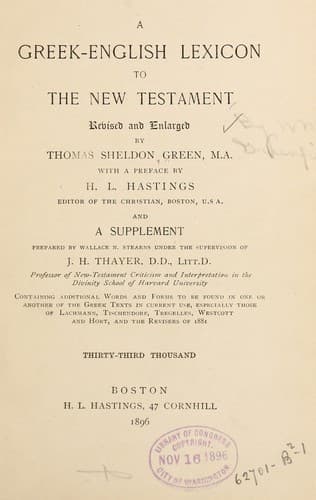
A Greek-English Lexicon to the New TestamentGreenfield, William
Religion
A Greek-English Lexicon to the New Testament
Greenfield, William
Bible. New Testament -- Dictionaries -- English; Greek language, Biblical -- Dictionaries -- English
of δεῖ)
necessary, 1 Pe. 1.6; proper,right, Ac. 19.36. 1 Ti. 5.13.
Δέος, δέους, τό, (δείδω, to fear)
fear, v.r. He. 12.28.
Δέρμα, ᾰτος, τό, (δέρω)
the skin of an animal, He. 11.37:
whence
Δερμάτῐνος, η, ον,
made of skin, leathern, Mat. 3.4. Mar. 1.6.
Δέρω,
f. δερῶ, a.1. ἔδειρα, 2. f. pass. δαρήσομια,
to skin, flay; hence, to beat, scourge, Mat. 21.35.
Mar. 12.3, 5; 13.9, et al.
Δεσμεύω, (δεσμός)
f. εύσω,
to bind, bind up, as a bundle, Mat. 23.4; to bind,
confine, Ac. 22.4.
Δεσμέω, ῶ, (fr. same)
f. ήσω,
to bind, confine, i.q. δεσμεύω, Lu. 8.29. L.G.
Δεσμή, ῆς, ἡ (δέω)
a bundle as of tares, Mat. 13.20.
Δεσμιος, ίου, ὁ, (fr. same)
one bound, a prisoner, Mat. 27.15, 16. Mar. 15.6, et al,
Δεσμός, οῦ, ὁ, pl. τά δεσμά, & οἱ δεσμοἱ, (fr. same)
a bond, any thing by which one is bound, a cord, chain,
fetters, &c.; and by meton. imprisonment, Lu. 8.29.
Ac. 16.26; 20.23, et al.; a string or ligament, as
of the tongue, Mar. 7.35; met. an impediment, infirmity,
Lu. 13.16.
Δεσμοφύλαξ, ᾰκος, ὁ, (δεσμός & φυλάσσω)
a keeper of a prison, jailer, Ac. 16.23, 27, 36. (ῠ). L.G.
Δεσμωτήριον, ίου, τό, (δεσμόω)
a prison, Mat. 11.2. Ac. 5.21, 23; 16.26.
Δεσμώτης, ου, ὁ, (fr. same)
a prisoner, i.q. δέσμιος, Ac. 27.1, 42.
Δεσπότης, ου, ὁ,
a lord, master, especially of salves, 1 Ti. 6.1, 2.
2 Ti. 2.21. Tit. 2.9. 1 Pe. 2.18; by impl. as denoting
the possession of supreme authority, Lord, sovereign,
used of God, Lu. 2.29. Ac. 4.24. Re. 6.10, and of Christ,
2 Pe. 2.1. Jude 4.
Δεῦρο,
adv. hither, here; used also as a sort of imperative,
come, come hither! Mat. 19.21. Mar. 10.21, et al.;
used of time, ἄχρι τοῦ δεῦρο, sc. χρόνου, to the present
time, Ro. 1.13.
Δεῦτε, i.e. δεῦρ' ἴτε,
an exclamation in the plural, of which the singular form
is δεῦρο, come, Mat. 4.19; 11.28, et al.; as a particle
of exhortation, incitement, &c., and followed by an
imperative, come now, &c. Mat. 21.38; 28.6, et al.
Δευτεραῖος, αία, αῖον, (δεύτερος)
on the second day of a certain state or process, and used
as an epithet of the subject or agent, Ac. 28.13.
Δεύτερον, neut. of δεύτερος,
used as an adv. the second time, again, Jno. 3.4;
21.16, et al.
Δευτερόπρωτος, ου, ὁ, ἡ, δεύτερος & πρῶτος)
second-first, an epithet of uncertain meaning, but probably
appropriated to the Sabbath following the first day of
unleavened bread, Lu. 6.1. N.T.
Δεύτερος, α, ον, (δύο)
second, Mat. 22.26, et al.; τὸ δεύτερον, again, the second
time, another time, Jude 5; so ἐκ δευτέρου, Mat. 26.42,
et al.; & ἐν τῷ δευτέρῳ, Ac. 7.13.
Δέχομαι,
f. ξομαι, p. δέδεγμαι, a.1. ἐδεξάμην,
to take into one's hands, &c. Lu. 2.28; 16.6, 7, et al.;
to receive, Ac. 22.5; 28.21. Phi. 4.18; to receive into and
retain, contain, Ac. 3.21; met. to receive by the hearing,
learn, acquire a knowledge of, 2 Co. 11.4. Ja. 1.21;
to receive, admit, grant access to, to receive kindly,
welcome, Mat.
Public-domain text, read in full here on John Shaqi.
Reviews
Reviews
No reviews yet
Be the first to share your thoughts on this work.
Elsewhere in the archive
Join the Discussion
Join the discussion
Sign in to leave a comment or review.
Sign InorCreate an account