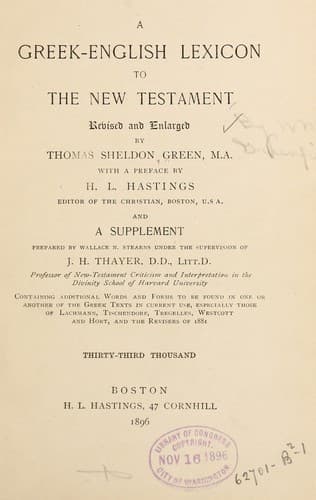
A Greek-English Lexicon to the New TestamentGreenfield, William
Religion
A Greek-English Lexicon to the New Testament
Greenfield, William
Bible. New Testament -- Dictionaries -- English; Greek language, Biblical -- Dictionaries -- English
pass. δέδομαι,
a.1. pass. ἐδόθην,
to give, bestow, present, Mat. 4.9; 6.11. Jno. 3.16; 17.2,
et al. freq.; to give, cast, throw, Mat. 7.6; to supply,
suggest, Mat. 10.19. Mar. 13.11; to distribute alms, Mat. 19.21.
Lu. 11.41, et al.; to pay tribute, &c. Mat. 22.17. Mar. 12.14.
Lu. 20.22; to be the author or source of a thing, Lu. 12.51.
Ro. 11.8, et al.; to grant, permit, allow, Ac. 2.27; 13.35.
Mat. 13.11; 19.11, et al.; to deliver to, intrust, commit to
the charge of any one, Mat. 25.15. Mar. 12.9, et al.; to give
or deliver up, Lu. 22.19. Jno. 6.51, et al.; to reveal, teach,
Ac. 7.38; to appoint, constitute, Ep. 1.22; 4.11; to consecrate,
devote, offer in sacrifice, 2 Co. 8.5. Gal. 1.4. Re. 8.3, et al.;
to present, expose one's self in a place, Ac. 19.31; to recompense,
Re. 2.23; to attribute, ascribe, Jno. 9.24. Re. 11.13;
fr. the Heb. to place, put, infix, inscribe, He. 8.10; 10.16, et al.;
to infix, impress, 2 Co. 12.7. Re. 13.16; to inflict, Jno. 18.22; 19.3.
2 Thes. 1.8; to give in charge, assign, Jno. 5.36; 17.4. Re. 9.5;
to exhibit, put forth, Mat. 24.24. Ac. 2.19; to yield, bear fruit,
Mat. 13.8; διδόναι ἐργασίαν, operam dare, to endeavour, strive,
Lu. 12.58; διδόναι ἀπόκρισιν, responsum dare, to answer, reply,
Jno. 1.22; διδόναι τόπον, locum dare, to give place, yield,
Lu. 14.9. Ro. 12.19.
Διεγείρω, (διά & ἐγείρω)
f. δειγερῶ, a.1. pass. διηγέρθην,
to arouse or awake thoroughly, Mat. 1.24. Mar. 4.38, 39. Lu. 8.24;
pass. to be raised, excited, agitated, as a sea, Jno. 6.18;
met. to stir up, arouse, animate, 2 Pe. 1.13; 3.1.
Διενθυμέομαι, οῦμαι, (διά & ἐνθυμέομαι)
to revolve thoroughly in the mind, consider carefully,
v.r. Ac. 10.19. L.G.
Διέξοδος, ου, ἡ, (διά & ἔξοδος)
a passage throughout; a line of road, a thoroughfare, Mat. 22.9.
Διερμηνευτής, οῦ, ὁ,
an interpreter, 1 Co. 14.28: (L.G.) from
Διερμηνεύω, a late compound used as an equivlent to the simple ἑρμηνεύω,
f. εύσω,
to explain, interpret, translate, Lu. 24.27. Ac. 9.36.
1 Co. 14.5, 13, 27; to be able to interpret, 1 Co. 12.30.
Διέρχομαι, (διά & ἔρχομαι)
f. ελεύσομαι, a.2. διῆλθον,
to pass through, Mar. 10.25. Lu. 4.30, et al.; to pass over,
cross, Mar. 4.35. Lu. 8.22; to pass along, Lu. 19.4; to proceed,
Lu. 2.15. Ac. 9.38, et al.; to travel through or over a country,
wander about, Mat. 12.43. Lu. 9.6, et al.; to transfix, pierce,
Lu. 2.35; to spread abroad, be prevalent, as a rumour, Lu. 5.15;
met. to extend to, Ro. 5.12.
Διερωτάω, ῶ, (διά & ἐρωτάω)
f. ήσω,
to sift by questionings, of persons; in N.T., of things, to
ascertain by inquiry, Ac. 10.17.
Διετής, έος, οῦς, ὁ, ἡ, τό, -ές, (δίς & ἔτος)
of two years; of the age of two years, Mat. 2.16:
whence
Διετία, ας, ἡ,
the space of two years, biennium, Ac. 24.27; 28.30. N.T.
Διηγέομαι, οῦμαι, (διά & ἡγέομαι)
f.ήσομαι,
pr. to lead throughout; to declare thoroughly, detail,
recount, relate, tell, Mar. 5.16; 9.9. Lu. 8.39. Ac. 8.33.
He.
Public-domain text, read in full here on John Shaqi.
Reviews
Reviews
No reviews yet
Be the first to share your thoughts on this work.
Elsewhere in the archive
Join the Discussion
Join the discussion
Sign in to leave a comment or review.
Sign InorCreate an account