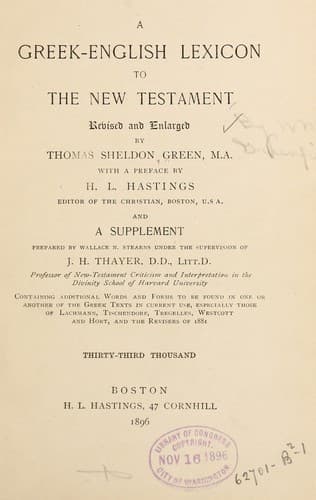
A Greek-English Lexicon to the New TestamentGreenfield, William
Religion
A Greek-English Lexicon to the New Testament
Greenfield, William
Bible. New Testament -- Dictionaries -- English; Greek language, Biblical -- Dictionaries -- English
Ἔᾱ,
interj. ha! an expression of surprise or displeasure,
Mar. 1.24. Lu. 4.34.
Ἐάν,
conj. if. The particulars of the use of ἐάν must be learnt
from the grammars. Ἐάν μή, except, unless; also equivalent to
ἀλλά, Gal. 2.16. Ἐάν, in N.T., as in the later Greek, is
substitued for ἄν after relative words, Mat. 5.19, et al. freq.
Ἐάνπερ,
a strengthing of ἐάν by the enclitic particle περ, if it be that,
if at all events, He. 3.6, 14; 6.3.
Ἑαυτοῦ, ῆς, οῦ, contr. αὑτοῦ, ῆς, οῦ, pl. ἑαυτῶν,
a reflective pronoun of the third person, himself, herself,
itself, Mat. 8.22; 12.26; 9.21, et al.;
also used for the first and second persons, Ro. 8.23. Mat. 23.31;
also equivalent to ἀλλήλων, Mar. 10.26. Jno. 12.19;
ἀφ' ἑαυτοῦ, ἀφ' ἑαυτῶν, of himself, themselves, voluntarily spontaneously,
Lu. 12.47; 21.30, et al.;
of one's own will merely, Jno. 5.19;
δι' ἑαυτοῦ, per se, of itself, in its own nature, Ro. 14.14;
ἐξ ἑαυτῶν, of one's self merely, 2 Co. 3.5;
καθ' ἑαυτόν, by one's self, alone, Ac. 28.16. Ja. 2.17;
παρ' ἑαθτῷ, with one's self, at home, 1 Co. 16.2;
πρὸς ἑαυτόν, to one's self, to one's home, Lu. 24.12. Jno. 20.10;
or, with one's self, Lu. 18.11.
Ἐάω, ῶ,
f. άσω, imperf. εἴων, a.1. εἴᾱσα,
to let, allow, permit, suffer to be done, Mat. 24.43.
Lu. 4.14, et al.; to let be, let alone, desist from, Lu. 22.51.
Ac. 5.38; to commit a ship to the sea, let her drive, Ac. 27.40.
Ἑβδομήκοντα, οἱ, αἱ, τά, (ἕβδομος)
seventy, Ac. 7.14, et al.; οἱ ἑβδομ. the seventy disciples,
Lu. 10.1, 17.
Ἑβδομηκοντάκις,
adv. seventy times, Mat. 18.22.
Ἕβδομος, η, ον, (ἑπτά)
seventh, Jno. 4.52. He. 4.4. et al.
Ἑβραϊκός, ή, όν,
Hebrew, Lu. 23.38:
from
Ἑβραῖος, αία, αῖον, v. ου, ὁ
a Hebrew, one descended from Abraham the Hebrew, 2 Co. 11.22.
Phil. 3.5; in N.T., a Jew of Palestine, opp. to Ἑλληνιστής, Ac. 6.1:
whence
Ἑβραΐς, ΐδος, ἡ, sc. διάλεκτος,
the Hebrew dialect, i.e. the Hebrœo-Aramœan dialect of Palestine,
Ac. 21.40, et al.
Ἑβραϊστί,
in Hebrew, Jno. 5.2; 19.13, et al.
Ἔδρᾰμον,
part. δραμών, see τρέχω.
Ἐγγίζω,
f. ίσω, At. ιῶ, p. ἤγγικα, a.1. ἤγγισα, (fr. ἐγγύς)
pr. to cause to approach; in N.T. intrans. to approach, draw
near, Mat. 21.1. Lu. 18.35, et al.; met. to be at hand, impend,
Mat. 3.2; 4.17, et al.; μέχρι θανάτου ἐγγίζειν, to be at the
point of death, Phi. 2.30; fr. Heb. to draw near to God, to
offer him reverence and worship, Mat. 15.8. He. 7.19. Ja. 4.8;
used of God, to draw near to men, assist them, bestow favours on
them, Ja. 4.8. L.G.
Ἐγγράφω,
f. ψω, p. pass. ἐγγέγραμμαι, (ἐν & γράφω)
to engrave, inscribe; met. to infix or impress deeply,
2 Co. 3.2, 3.
Ἔγγυος, ου, ὁ, ἡ, (fr. ἐγγύη, a pledge)
a surety, sponsor, He. 7.22.
Ἐγγύς,
adv. near, as to place, Lu. 19.11, et al.;
close at hand, Ro. 10.8;
near, in respect of ready interposition, Phi. 4.5;
near, as to time, Mat. 24.32, 33, et al.;
near to God, as being in covenant with him, Ep. 2.13;
Public-domain text, read in full here on John Shaqi.
Reviews
Reviews
No reviews yet
Be the first to share your thoughts on this work.
Elsewhere in the archive
Join the Discussion
Join the discussion
Sign in to leave a comment or review.
Sign InorCreate an account