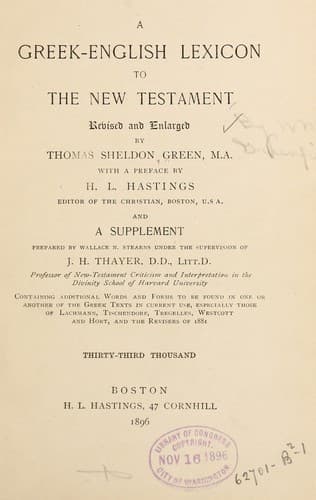
A Greek-English Lexicon to the New TestamentGreenfield, William
Religion
A Greek-English Lexicon to the New Testament
Greenfield, William
Bible. New Testament -- Dictionaries -- English; Greek language, Biblical -- Dictionaries -- English
οἱ ἐγγύς, the people near to God, the Jews, Ep. 2.17.
Ἐγγύτερον,
adv. (pr. neut. of ἐγγύτερος, comp. of ἐγγύς) nearer,
Ro. 13.11.
Ἐγείρω,
f. ἐγερῶ, p. ἐγήγερκα, a.1. ἤγειρα, p. pass. ἐγήγερμαι,
a.1. pass. ἠγέρθην,
to excite, arouse, awaken, Mat. 8.25, et al.; mid. to awake,
Mat. 2.13, 20, 21, et al.; met. mid. to rouse one's self to a
better course of conduct, Ro. 13.11. Ep. 5.14; to raise from
the dead, restore to life, Jno. 12.1, et al., and mid. to rise
from the dead, Mat. 27.52. Jno. 5.21, et al.; met. to raise as
it were from the dead, 2 Co. 4.14; to raise up, cause to rise up
from a recumbent posture, Ac. 3.7, and mid. to rise up, Mat. 17.7,
et al.; to restore to health, Ja. 5.15; met. et seq. ἐπί, to
excite to war, mid. to rise up against, Mat. 24.7, et al; to raise
up again, rebuild, Jno. 2.19, 20; to raise up from a lower place,
to draw up or out of a ditch, Mat. 12.11; fr. Heb. to raise up,
to cause to arise or exist, Ac. 13.22, 23; mid. to arise, exist,
appear, Mat. 3.9; 11.11, et al.:
whence
Ἔγερσις, εως, ἡ,
pr. the act of waking or rising up; resurrection, resuscitation,
Mat. 27.53.
Ἐγκάθετος, ου, ὁ, ἡ, (ἐν & καθίημι)
suborned, Lu. 20.20.
Ἐγκαίνια, ίων, τά, (ἐν & καινός)
initiation, consecration; in N.T., the feast of dedication,
an annual festival of eight days in the month Kisleu, Jno. 10.22.
Ἐγκαινίζω,
f. ίσω, a.1. ἐνεκαίνισα, p. pass. ἐγκεκαίνισμαι,
to handsel, initiate, consecrate, dedicate, renovate;
to institute, He. 9.18; 10.20. S.
Ἐγκαλέω, ῶ, (ἐν & καλέω)
f. έσω,
to bring a charge against, accuse; to institute judicial
proceedings, Ac. 19.38, 40; 23.28, 29; 26.2, 7. Ro. 8.33.
Ἐγκαταλείπω, (ἐν & καταλείπω)
f. ψω, a.2. ἐγκατέλιπον,
to leave in a place or situation, Ac. 2.27; to leave behind;
to forsake, abandon, Mat. 27.46, et al.; to leave, as a remnant
from destruction, Ro. 9.29.
Ἐγκατοικέω, ῶ, (ἐν & κατοικέω)
f. ήσω,
to dwell in or among, 2 Pe. 2.8.
Ἐγκεντρίζω, (ἐν & κεντρίζω, to prick)
f. ίσω,
to ingraft; met. Ro. 11.17, 19, 23, 24.
Ἔγκλημα, ατος, τό, (ἐγκαλέω)
an accusation, charge, crimination, Ac. 23.29; 25.16.
Ἐγκομβόομαι, οῦμαι,(κόμβος, a string, band; whence ἐγκόμβωμα,
a garment which is fastened by tying)
f. ώσομαι,
pr. to put on a garment which is to be tied; in N.T.,
to put on, clothe; met. 1 Pe. 5.5.
Ἐγκοπή, ῆς, ἡ,
pr. an incision, e.g. a trench, &c. cut in the way of an
enemy; an impeditment, hindrance, 1 Co. 9.12: (L.G.)
from
Ἐγκόπτω, (ἐν & κόπτω)
f. ψω,
pr. to cut or strike in; hence, to impede, interrupt, hinder,
Ro. 15.22. 1 Thes. 2.18. 1 Pe. 3.7. Gal. 5.7.
Ἐγκράτεια, ας, ἡ, (ἐγκρατής)
self-control, continence, temperance, Ac. 24.25, et al.
Ἐγκρατεύομαι,
f. εύσομαι,
to possess the power of self-control or continence, 1 Co. 7.9;
to practise abstinence, 1 Co. 9.25.
Ἐγκρᾰτής, έος, ὁ, ἡ, (κράτος)
strong, stout; possessed of mastery; master of self, Tit. 1.8.
Ἐγκρίνω, (ἐν & κρίνω)
Public-domain text, read in full here on John Shaqi.
Reviews
Reviews
No reviews yet
Be the first to share your thoughts on this work.
Elsewhere in the archive
Join the Discussion
Join the discussion
Sign in to leave a comment or review.
Sign InorCreate an account