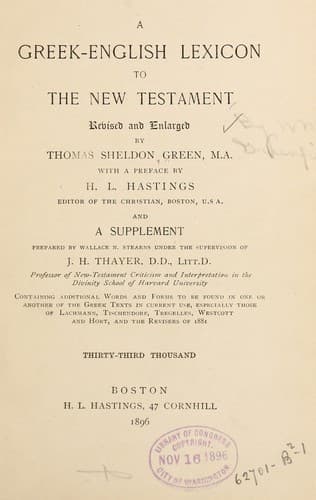
A Greek-English Lexicon to the New TestamentGreenfield, William
Religion
A Greek-English Lexicon to the New Testament
Greenfield, William
Bible. New Testament -- Dictionaries -- English; Greek language, Biblical -- Dictionaries -- English
ἴδοιμι, subj. ἴδω, inf. ἰδεῖν,
part. ἰδών, see ὁράω.
Εἶδος, εος, τό,
form, external appearance, Lu. 3.22; 9.29. Jno. 5.37; kind,
species, 1 Thes. 5.22; sight, perception, 2 Co. 5.7.
Εἰδῶ, εἰδέναι, εἰδώς,
see οἶδα.
Εἰδωλεῖον, ου, τό, (εἴδωλον)
a heathen temple, 1 Co. 8.10. N.T.
Εἰδωλόθῠτος, ον, (εἴδωλον & θύω)
pr. sacrificed to an idol; meton. the remains of victims
sacrificed to idols, reserved for eating, Ac. 15.29; 21.25,
et al. N.T.
Εἰδωλολατρεία, ας, ἡ, (εἴδωλον & λατρεία)
idolatry, worship of idols, 1 Co. 10.14. Gal. 2.20, et al. N.T.
Εἰδωλολάτρης, ου, ὁ, (εἴδωλον & λάτρις, a servant, worshipper)
an idolater, worshipper of idols, 1 Co. 5.10, 11; 6.9; 10.7,
et al. N.T. (ᾰ)
Εἴδωλον, ου, τό, (εἶδος)
pr. a form, shape, figure; image or statue; hence, an idol,
image of a god, Ac. 7.41, et al.; meton. a heathen god,
1 Co. 8.4, 7, et al.; for εἰδωλόθυτον, the flesh of victims
sacrificed to idols, Ac. 15.20.
Εἰκῆ,
adv. without plan or system; without cause, lightly, rashly,
Mat. 5.22. Co. 2.18; to no purpose, in vain, Ro. 13.4.
1 Co. 15.2. Gal. 3.4; 4.11.
Εἴκοσι, οἱ, αἱ, τά,
twenty, Lu. 14.31, et al.
Εἰκοσιπέντε (εἴκοσι & πέντε)
twenty-five, Jno. 6.19.
Εἰκοσιτέσσαρες, (εἴκοσι & τέσσαρες)
twenty-four, Re. 5.8, 14.
Εἰκοσιτρεῖς, (εἴκοσι & τρεῖς)
twenty-three, 1 Co. 10.8.
Εἴκω,
f. ξω,
to yield, give place, submit, Gal. 2.5.
Εἰκών, ονος, ἡ,
a material image, likeness, effigy, Mat. 22.20. Mar. 12.16, et al.;
a similitude, representation, exact image, 1 Co. 11.7, et al.;
resemblance, Ro. 8.29, et al.
Εἰλικρίνεια, ας, ἡ,
clearness, purity, met. sincerity, integrity, ingenuousness,
1 Co. 5.8, et al.:
from
Εἰλικρῐνής, έος, ὁ, ἡ, (εἵλη, sun shine & κρίνω)
pr. that which being viewed in the sunshine is found clear
and pure; met. spotless, sincere, ingenuous, Phi. 1.10.
2 Pe. 3.1.
Εἱλίσσω, (εἱλέω, to roll)
f. ξω,
properly Tonic for ἑλίσσω, to roll up, Re. 6.14.
Εἰμί,
imperf. ἦν & ἤμην, f. ἔσομαι, imperat. ἴσθι, ἔστω & ἤτω, subj. ὦ,
inf. εἶναι, part. ὤν,
a verb of existence, to be, to exist, Jno. 1.1; 17.5. Mar. 6.30.
Lu. 4.25, et al. freq.; ἐστί, it is possible, proper, He. 9.5;
a simple copula to the subject and predicate, and therefore in
itself affecting the force of the sentence only by its tense,
mood, &c., Jno. 1.1; 15.1, et al. freq.; it also forms a frequent
circumlocution with the participles of the present and perfect
of other verbs, Mat. 19.22. Mar. 2.6, et al.
Εἶμι,
to go, come, but generally with a future signification,
v.r. Jno. 7.34, 36.
Εἵηεκεν, equivalent to ἕνεκα,
on account of, 2 Co. 7.12, ter.
Εἶπα,
Mat. 26.25, et al., imperat. εἶπον or εἰπόν, v.r. Ac. 28.26,
see λέγω.
Εἴπερ,
a strengthening of εἰ by the enclitic particle περ, if indeed,
if it be so that, Ro. 8.9. 1 Co. 15.15; since indeed, since,
2 Thes. 1.6. 1 Pe. 2.3; although indeed, 1 Co. 8.5.
Εἶπον,
imperat. εἰπέ, subj. εἴπω, opt. εἴποιμι, inf. εἰπεῖν,
Public-domain text, read in full here on John Shaqi.
Reviews
Reviews
No reviews yet
Be the first to share your thoughts on this work.
Elsewhere in the archive
Join the Discussion
Join the discussion
Sign in to leave a comment or review.
Sign InorCreate an account