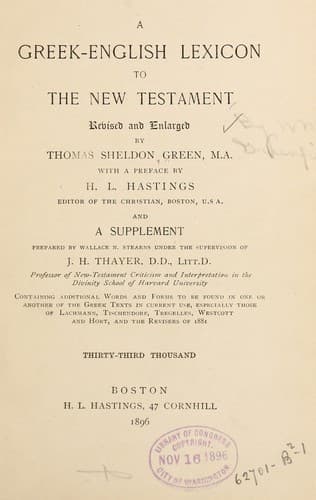
A Greek-English Lexicon to the New TestamentGreenfield, William
Religion
A Greek-English Lexicon to the New Testament
Greenfield, William
Bible. New Testament -- Dictionaries -- English; Greek language, Biblical -- Dictionaries -- English
f. ινῶ,
to judge or reckon among, consider as belonging to, adjudge
to the number of, class with, place in the same rank,
2 Co. 10.12 (ῑ)
Ἐγκρύπτω, (ἐν & κρύπτω)
f. ψω,
to conceal in any thing; to mix, intermix, Mat. 13.33. Lu. 13.21.
Ἔγκῠος, ου, ἡ, (ἐν & κύω)
with child, pregnant, Lu. 2.5.
Ἐγχρίω, (ἐν & χρίω)
f. ίσω,
to rub in, anoint, Re. 3.18. (ῑ)
Ἐγώ,
gen. ἐμοῦ & μου, Ι.
Ἐδαφίζω,
f. ίσω, At. ιῶ,
pr. to form a level and firm surface; to level with the ground,
overthrow, raze, destroy, Lu. 19.44:
from
Ἔδαφος, εος, τό,
pr. a bottom, base, hence, the ground, Ac. 22.7.
Ἑδραῖος, αία, αῖον, (ἕδρα, a seat)
sedentary; met. settled, steady, firm, stedfast, constant,
1 Co. 7.37; 15.58. Col. 1.23.
Ἑδραίωμα, ατος, τό, (ἑδραιόω, to settle, fr. preceding)
a basis, foundation, 1 Ti. 3.15. N.T.
Ἐθελοθρησκεία, ας, ἡ, (ἐθέλω & θρησκεία)
self-devised worship, supererogatory worship, will-worship,
Col. 2.23.
Ἐθέλω & θέλω, the latter being the form in the present in N.T.,
f. ἐθελήσω & θελήσω, imperf. ἤθελον, a.1. ἠθέλησα,
to exercise the will, properly by an unimpassioned operation;
to be willing, Mat. 17.4, et al.; to be inclined, disposed,
Ro. 13.3, et al.; to choose, Lu. 1.62; to intend, design,
Lu. 14.28, et al.; to will, Jno. 5.21; 21.22, et al.;
ἤθελον, I could wish, Gal. 4.20.
Ἐθίζω, (ἔθος)
f. ίσω, p. pass. εἴθισμαι,
to accustom; pass. to be customary, Lu. 2.27.
Ἐθνάρχης, ου, ὁ, (ἔθνος & ἄρχω)
a governor, chief, or head of any tribe or nation,
prefect, 2 Co. 11.32. L.G.
Ἐθνικός, ή, όν, (ἔθνος)
national; in N.T., gentile, heathen, not Israelitish,
Mat. 6.7; 18.17: (L.G.)
whence
Ἐθνικῶς,
adv. after the manner of the gentiles, heathenishly,
Gal. 2.14. N.T.
Ἔθνος, εος, τό,
a multitude, company, Ac. 17.26. 1 Pe. 2.9. Re. 21.24;
a nation, people, Mat. 20.25; 21.43, et al.; pl. ἔθνη,
fr. the Heb., nations or people, as distinguished from
the Jews, the heathen, gentiles, Mat. 4.15; 10.5.
Lu. 2.32, et al.
Ἔθος, εος, τό,
a custom, usage, Lu. 2.42; 22.39, et al.; an institute,
rite, Lu. 1.9. Ac. 6.14; 15.1, et al.
Εἰ,
conj. if, Mat. 4.3, 6; 12.7. Ac. 27.39, et al. freq.;
since, Ac. 4.9, et al.;
whether, Mar. 9.23. Ac. 17.11, et al.;
that, in certain expressions, Ac. 26.8, 23. He. 7.15;
by a suppression of the apodosis of a sentence εἰ serves to
express a wish; O if! O that! Lu. 19.42; 22.42;
also a strong negation, Mar. 8.12. He. 3.11; 4.3;
εἰ καί, if even, though, although, Lu. 18.4, et al.;
εἰ μή, unless, except, Mat. 11.27, et al.;
also equivalent to ἀλλά, but, Mat. 12.4. Mar. 13.32. Lu. 4.26, 27;
εἰ μήτι, unless perhaps, unless it be, Lu. 9.13, et al.;
εἴ τις, εἴ τι, pr. if any one: whosoever, whatsoever, Mat. 18.28,
et al. The syntax of this particle must be learnt from the grammars.
As an interrogative particle, whether, Ac. 17.11, et al.;
in N.T. as a mere note of interrogation, Lu. 22.49, et al.
Εἶδον,
imperat. ἰδέ & ἴδε, optat.
Public-domain text, read in full here on John Shaqi.
Reviews
Reviews
No reviews yet
Be the first to share your thoughts on this work.
Elsewhere in the archive
Join the Discussion
Join the discussion
Sign in to leave a comment or review.
Sign InorCreate an account