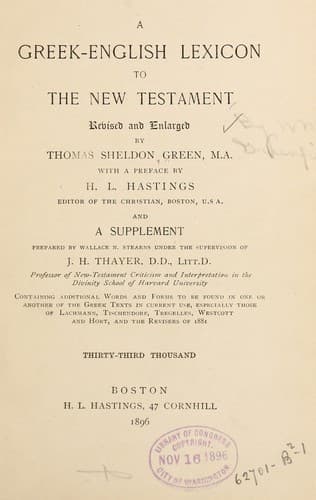
A Greek-English Lexicon to the New TestamentGreenfield, William
Religion
A Greek-English Lexicon to the New Testament
Greenfield, William
Bible. New Testament -- Dictionaries -- English; Greek language, Biblical -- Dictionaries -- English
ἐξιέναι, part. ἐξιών,
to go out or forth, Ac. 13.42; to depart, Ac. 17.15; 20.7;
ἐπὶ τῆν γῆν, to get to land, from the water, Ac. 27.43.
Ἐξελέγχω, (ἐξ & ἐλέγχω)
f. ξω,
to search thoroughly, to test; to convict; by impl. to punish,
Jude 15.
Ἐξέλκω, (ἐξ & ἕλκω)
f. ξω,
to draw or drag out; met. to withdraw, allure, hurry away,
Ja. 1.14.
Ἐξέραμα, ατος, τό, (ἐξεράω, to vomit)
vomit, 2 Pe. 2.22. L.G.
Ἐξερευνάω, ῶ, (ἐξ & ἐρευνάω)
f. ήσω,
to search out, to examine closely, 1 Pe. 1.10.
Ἐξέρχομαι, (ἐξ & ἔρχομαι)
f. ἐξελεύσομαι, a.2. ἐξῆλθον, p. ἐξελήλυθα,
to go or come out of; to come out, Mat. 5.26; 8.34, et al.;
to proceed, emanate, take rise from, Mat. 2.6; 15.18.
1 Co. 14.36, et al.; to come abroad, 1 Jno. 4.1, et al.;
to go forth, go away, depart, Mat. 9.31. Lu. 5.8, et al.;
to escape, Jno. 10.39; to pass away, come to an end, Ac. 16.19.
Ἔξεστι
impers., part. ἐξόν, it is possible; it is permitted, it is
lawful, Mat. 12.2, 4, et al.
Ἐξετάζω, (ἐξ & ἐτάζω, to inquire, examine)
f. άσω,
to search out; to inquire by interrogation, examine strictly,
Mat. 2.8; 10.11; to interrogate, Jno. 21.12.
Ἐξηγέομαι, οῦμαι, (ἐξ & ἡγέομαι)
f. ήσομαι,
to be a leader; to detail, to set forth in language; to tell,
narrate, recount, Lu. 24.35. Ac. 10.8, et al.; to make known,
reveal, Jno. 1.18.
Ἑξήκοντα, οἱ, αἱ, τά, (ἕξ)
sixty, Mat. 13.8, 23, et al.
Ἑξῆς,
adv. successively, in order; in N.T., with the art., ὁ, ἡ, τό ἑξῆς,
next, Lu. 7.11; 9.37, et al.
Ἐξηχέω, ῶ, (ἐξ & ἠχέω)
f. ήσω, p. pass. ἐξήχημαι,
to make to sound forth or abroad; pass. to sound forth, be
promulgated, 1 Thes. 1.8. L.G.
Ἔξις, εως, ἡ, (ἔχω)
a condition of body or mind, strictly, as resulting from
practice; habitude, He. 5.14.
Ἐξίστημι, & ἐξιστάω, ῶ, (ἐξ & ἵστημι)
f. ἐκστήσω, a.1. ἐξέστησα, later p. ἐξέστακα,
trans. pr. to put out of its place; to astonish, amaze,
Lu. 24.22. Ac. 8.9, 11; intrans. a.2. ἐξέστην, & mid. ἐξίσταμαι,
to be astonished, Mat. 12.22, et al.; to be beside one's self,
Mar. 3.21. 2 Co. 5.13.
Ἐξισχύω, (ἐξ & ἰσχύω)
f. ύσω,
to be fully able, Ep. 3.18. L.G.
Ἔξοδος, ου, ἡ, (ἐξ & ὁδός)
a way out, a going out; a going out, departure, He. 11.22;
met. a departure from life, decease, death, Lu. 9.31. 2 Pe. 1.15.
Ἐξολοθρεύω, (ἐξ & ὀλοθρεύω)
f. εύσω,
to destroy utterly, exterminate, Ac. 3.23. L.G.
Ἐξομολογέω, ῶ, (ἐξ & ὁμολογέω)
f. ησω
to agree, bind one's self, promise, Lu. 22.6; mid. to confess,
Mat. 3.6; to profess openly, Phi. 2.11. Re. 3.5; to make open avowal
of benefits; to praise, celebrate, Mat. 11.25. Lu. 10.21, et al. L.G.
Ἐξόν,
see Ἔξεστι.
Ἐξορκίζω, (ἐξ & ὁρκίζω)
f. ίσω,
to put an oath to a person, to adjure, Mat. 26.63:
whence
Ἐξορκιστής, οῦ, ὁ,
pr. one who puts an oath; in N.T., an exorcist, one who by various
kinds of incantations, &c. pretended to expel demons, Ac. 19.13.
Ἐξορύσσω, (ἐξ & ὀρύσσω)
f. ξω,
Public-domain text, read in full here on John Shaqi.
Reviews
Reviews
No reviews yet
Be the first to share your thoughts on this work.
Elsewhere in the archive
Join the Discussion
Join the discussion
Sign in to leave a comment or review.
Sign InorCreate an account