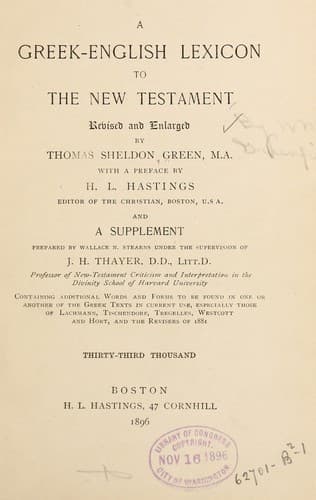
A Greek-English Lexicon to the New TestamentGreenfield, William
Religion
A Greek-English Lexicon to the New Testament
Greenfield, William
Bible. New Testament -- Dictionaries -- English; Greek language, Biblical -- Dictionaries -- English
to dig out or through, force up, Mar. 2.4; to pluck out the
eyes, Gal. 4.15.
Ἐξουδενόω,
Mar. 9.12, equivalent to
Ἐξουθενέω, ῶ, (ἐξ & οὐθέν, a later form of οὐδέν)
f. ήσω,
to make light of, set at nought, despise, contemn, treat with
contempt and scorn, Lu. 18.9, et al.; to neglect, disregard,
1 Thes. 5.20; ἐξουθενημένος, abject, contemptible, 2 Co. 10.10;
by impl. to reject with contempt, Ac. 4.11. S.
Ἐξουσία, ας, ἡ (ἔξεστι)
power, ability, faculty, Mat. 9.8; 10.1, et al.; efficiency,
energy, Lu. 4.32, et al.; liberty, license, Jno. 10.18. Ac. 5.4;
authority, rule, dominion, jurisdiction, Mat. 8.9; 28.18;
meton. pl. authorities, potentates, powers, Lu. 12.11.
1 Co. 15.24. Ep. 1.21; right, authority, full power,
Mat. 9.6; 21.23; privilege, prerogative, Jno. 1.12; perhaps,
a veil, 1 Co. 11.10:
whence
Ἐξουσιάζω,
f. άσω,
to have or exercise power or authority over any one, Lu. 22.25;
to possess independent control over, 1 Co. 7.4, bis; pass. to
be subject to, under the power or influence of, 1 Co. 6.12. L.G.
Ἐξοχή, ῆς, ἡ, (ἐξέχω, to be prominent)
pr. prominency, any thing prominent; in N.T., eminence,
distinction, Ac. 25.23.
Ἐξυπνίζω,
f. ίσω,
to awake, arouse from sleep, Jno. 11.11: (L.G.) from
Ἔξυπνος, ου, ὁ, ἡ, (ἐξ & ὕπνος)
awake, aroused from sleep, Ac. 16.27. L.G.
Ἔξω, (ἐξ)
adv. without, out of doors, Mat. 12.46, 47;
ὁ, ἡ, τὸ ἔξω, outer, external, foreign, Ac. 26.11. 2 Co. 4.16;
met. not belonging to one's community, Mar. 4.11. 1 Co. 5.12, 13;
out, away, from a place or person, Mat. 5.13; 13.48;
as a prep. out of, Mar. 5.10:
whence
Ἔξωθεν,
adv. outwardly, externally, Mat. 23.27, 28. Mar. 7.15; ὁ, ἡ, τὸ ἔξωθεν,
outer, external, Mat. 23.25. Lu 11.39; τὸ ἔξωθεν, the exterior,
Lu. 11.40; οἱ ἔξωθεν, those who do not belong to the Christian
community, 1 Ti. 3.7, et al.
Ἐξωθέω, ῶ, (ἐξ & ὠθέω)
f. ήσω, & ώσω, a.1. ἐξέωσα, in N.T. ἔξωσα,
to expel, drive out, Ac. 7.45; to propel, urge forward, Ac. 27.39.
Ἐξώτερος, α, ον, (comp. of ἔξω)
outer, exterior, external, Mat. 8.12; 22.13; 25.30. S.
Ἕοικα
p., with pr. sig., from absol. εἴκω, to be like, Ja. 1.6, 23.
Ἑορτάζω,
f. άσω,
to keep a feast, celebrate a festival, 1 Co. 5.8:
from
Ἑορτή, ῆς, ἡ
a solemn feast, public festival, Lu. 2.41; 22.1. Jno. 13.1;
spc. used of the passover, Mat. 26.5; 27.15, et al.
Ἐπαγγελία, ας, ἡ,
annunciation, 2 Ti. 1.1; a promise, act of promising,
Ac. 13.23, 32; 23.21; meton. the thing promised, promised
favour and blessing, Lu. 24.49. Ac. 1.4, et al.:
from
Ἐπαγγέλλω, (ἐπί & ἀγγέλλω)
f. ελώ,
to declare, announce; mid. to promise, undertake, Mar. 14.11.
Ro. 4.21, et al.; to profess, 1 Ti. 2.10:
whence
Ἐπάγγελμα, ατος, τό,
a promise, 2 Pe. 3.13; meton. promised favour or blessing,
2 Pe. 1.4.
Ἐπάγω, (ἐπί & ἄγω)
f. άξω, a.2. ἐπήγαγον
to bring upon, cause to come upon, 2 Pe. 2.1, 5; met. to cause
to be imputed or attributed to, to bring guilt upon, Ac.
Public-domain text, read in full here on John Shaqi.
Reviews
Reviews
No reviews yet
Be the first to share your thoughts on this work.
Elsewhere in the archive
Join the Discussion
Join the discussion
Sign in to leave a comment or review.
Sign InorCreate an account