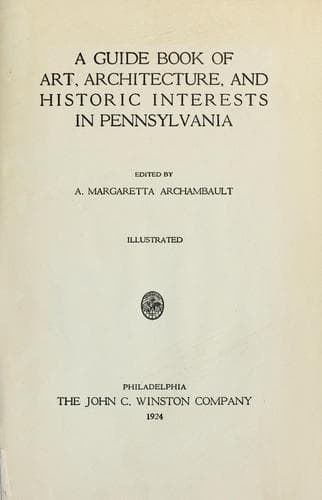
A guide book of art, architecture, and historic interests in Pennsylvania
History
A guide book of art, architecture, and historic interests in Pennsylvania
Architecture -- Pennsylvania; Art -- Pennsylvania; Historic buildings -- Pennsylvania; Pennsylvania -- Guidebooks; Pennsylvania -- History
In 1762, Richard Peters of Philadelphia obtained a patent for 388 acres
of land at Boiling Springs, and executed a deed to John S. Rigby & Co.,
for twenty-nine acres on which they had already commenced the erection
of a blast furnace, they bought two ore banks at the foot of South
Mountain, and soon after added 1614 acres of land, and called the
property “Carlisle Iron Works”; it passed through several ownerships,
until, in 1792, Michael Ege became sole owner; the furnace produced
twelve to fifteen tons of metal a week, mostly pig iron, but they also
cast stoves, fire backs, and hollow ware. William Denning, in 1776, made
two wrought iron cannon in Mount Holly Gap, about six miles south of
Carlisle, the first ever made; one in use at the Battle of Brandywine
was captured by the British and deposited finally in the Tower of
London; the British Government offered a large sum of money and an
annuity to William Denning, to instruct them how to make wrought iron
cannon, but he refused; he died in 1830, age ninety-three, at his home
near Newville, his monument there, given by the state, shows a square
marble base surmounted by a cannon. Pine Grove Furnace was built on
Mountain Creek, halfway between Carlisle and Gettysburg, the recorded
ownership dates from a proprietary grant in 1762 for 450 acres on
Mountain Creek to Thomas Pope; it is now part of the State Forestry
reservation.
VII
NORTHAMPTON COUNTY
Formed March 11, 1752; named by Thomas Penn; prior to the Revolution
comprised all the northeast section of Pennsylvania; chief industries,
Bethlehem Iron and Steel Works, where 15,000 men are employed day and
night; silk mills, graphite works, and other manufactories. Here were
Washington’s storehouses along the Delaware River, with supplies for all
branches of the army; a point of attack by the British battling between
West Point and Trenton, buildings are still in evidence. The famous
backwoods rifles used by two thousand Pennsylvanians against the British
at Boston were made here.
County seat, EASTON, founded by Thomas Penn, 1751; at “The Forks of the
Delaware, where the water is deep and smooth,” population 33,813. In
center of the public square is the monument to soldiers of this county
in the Civil War, on site of the old Northampton court house that stood
for a hundred years; on its threshold was promulgated the Declaration of
Independence, the same day as in Philadelphia; the old court house bell,
that rang out then, is still doing public service. The first flag,
combining stars and stripes, as an emblem of a new nation, was made
here, showing thirteen eight pointed stars and thirteen stripes in the
field, this flag is said to be the one now in the Easton Public Library,
deposited in 1821, after being used in the War of 1812; in a special
room of the
[Illustration: NORTHAMPTON COUNTY]
Public-domain text, read in full here on John Shaqi.
Reviews
Reviews
No reviews yet
Be the first to share your thoughts on this work.
Elsewhere in the archive
Join the Discussion
Join the discussion
Sign in to leave a comment or review.
Sign InorCreate an account