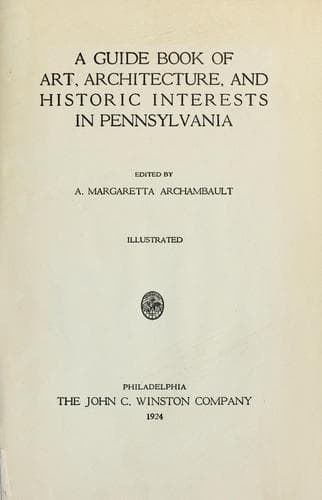
A guide book of art, architecture, and historic interests in Pennsylvania
History
A guide book of art, architecture, and historic interests in Pennsylvania
Architecture -- Pennsylvania; Art -- Pennsylvania; Historic buildings -- Pennsylvania; Pennsylvania -- Guidebooks; Pennsylvania -- History
library is the private collection of Samuel Sitgreaves, with rare
volumes of American history. Next to Sitgreaves’ office was the home and
shop of Henry Derringer, a gunmaker of the Revolution, whose son
invented the Derringer pistol. On the public square, Light Horse Harry
Lee, from Virginia, recruited his troop of Pennsylvania Germans, and
horses. Valuable papers and moneys belonging to the state and national
government were placed in the custody of Robert Levers, during British
occupancy of Philadelphia.
The old Union Church, now the Reformed, on North Third Street, stone,
colonial, built, 1775-76, was used as a hospital in the Revolution; this
is the principal residential street, and entrance to LAFAYETTE COLLEGE,
founded, 1832, by James Madison Porter, Secretary of War; has
interesting collection of portraits of Lafayette, in oil and black and
white, also valuable old engravings; on the campus is statue of
Lafayette, by Daniel Chester French, given by Morris L. Clothier, Esq.
In the New Century Art Club, New and Porter Streets, lectures on art and
exhibitions are given. A bridge leads across the Delaware to
Phillipsburg, New Jersey, first wooden bridge built, 1797; north of the
bridge is Riverside Park, leading to North Delaware Road and the
Delaware Water Gap; the Wind Gap has precipitous sides; very beautiful
scenery is on the River Road.
In July, 1782, Washington came from Bethlehem to Easton. BETHLEHEM, in
Lehigh County, is the seat of government of the Moravian economy, from
Moravia in Bohemia, in the western hemisphere, dating back to 1740;
these pioneers belonged to the Church of the Brethren, organized in
1457 by followers of John Huss about forty years after he had been
burned at the stake for conscience’ sake; the little church was revived
in Saxony in 1722; to this church Count Nicholas L. Zinzendorf granted
an asylum on his own estate; the count visited the Brethren here in
1741. On July 25, 1782, Washington, with Colonel Trumbull and Major
Welker, stayed overnight at the Sun Inn; Brother Ettwein and others of
the Fraternity called to pay their respects; the Sun Inn was built in
1761, Peter Warbas the first host; the suite occupied by General
Washington and his wife is still shown to visitors. During the
Revolution the Moravian settlement experienced many horrors and
discomforts of war; the tramp of armed men through its quiet streets
began in July, 1775; in December most of the houses were taken for
hospitals, being on the main route of travel from the eastern states;
many distinguished soldiers were here, Greene, Knox, Gates, Stirling,
Sullivan, Schuyler, von Steuben, De Kalb, Pulaski, de Chastelleux, also
Samuel and John Adams, Hancock, Laurens, Livingston, Boudinot, Reed,
Rittenhouse, Gerard; in autumn of 1777, Lafayette, under careful nursing
of a Moravian sister, Liesel Beckel, rapidly recovered from a wound
received in the Battle of Brandywine. General hospital of the
Continental Army was here, 1776-78.
Public-domain text, read in full here on John Shaqi.
Reviews
Reviews
No reviews yet
Be the first to share your thoughts on this work.
Elsewhere in the archive
Join the Discussion
Join the discussion
Sign in to leave a comment or review.
Sign InorCreate an account