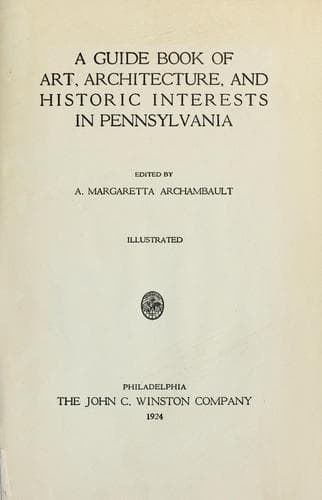
A guide book of art, architecture, and historic interests in Pennsylvania
History
A guide book of art, architecture, and historic interests in Pennsylvania
Architecture -- Pennsylvania; Art -- Pennsylvania; Historic buildings -- Pennsylvania; Pennsylvania -- Guidebooks; Pennsylvania -- History
Formed February 26, 1846; named for Honorable John Blair, native of this
county, and public-spirited citizen; in 1820, he laid out, and was
President of the Huntingdon, Cambria and Indiana Turnpike, first in this
section. Blair County lies in the beautiful Juniata Valley, settled by
Scotch-Irish, English, and Germans; much of the soil is very fertile.
Chief industries, agriculture, coal mining, and manufacturing. It is the
center of a network of roads, mostly built as turnpikes from 1830-50;
now state roads.
TYRONE, altitude 692 feet above sea level, population 9084; outlet for
important bituminous coal products; lies in a basin formed by the base
line of old Tussey, a famous mountain, and the bold ridge known as Bald
Eagle. The home of Captain John Logan, eldest son of Shikellamy, was at
mouth of Bald Eagle Creek; second son, James Logan, the Mingo chief,
named for Secretary Logan of Germantown, went west to the Ohio; his son
(Tod-kahdohs) married a daughter of Chief Cornplanter. About three miles
east from Tyrone is the Sinking Valley, named from the Sinking Creek, an
underground watercourse; near is BIRMINGHAM, with a pleasure ground,
where there are one hundred springs and a large cave; a school for girls
is here.
ALTOONA, population 60,331; altitude 1171 feet above sea level; founded
by the Pennsylvania Railroad in 1850, consists almost entirely of their
shops and workmen’s houses. St. Luke’s Protestant Episcopal Church,
native stone, first built in 1858; second building in 1881, using the
same stone; Gothic, F. C. Withers, New York, architect; has an English
window, also one by Tiffany, “The Resurrection,” exhibited in Paris in
1900; memorial to Almet E. Read, Esq.; brick rectory and school, gift of
General John Watts De Peyster, as memorial to his daughter, first school
for advanced education in Altoona.
In the Logan House, built, 1854, by the Pennsylvania Railroad, was held
the conference of the loyal war governors in 1862, namely, A. G. Curtin,
Pennsylvania; John A. Andrew, Massachusetts; Richard Yates, Illinois;
Israel Washburn, Jr., Maine; Edward Solomon, Wisconsin; Samuel J.
Kirkwood, Iowa; O. P. Morton (by D. G. Ross, his representative),
Indiana; William Sprague, Rhode Island; F. H. Pierpont, Virginia; David
Tod, Ohio; N. S. Berry, New Hampshire; Austin Blair, Michigan; to devise
ways and means for coöperating with President Lincoln in suppressing the
Rebellion. King Edward VII, as Prince of Wales, stopped here. On the
William Penn Highway, formerly an old portage road, is site of an early
historic hotel, “Fountain Inn,” mentioned by Dickens in “American
Notes”; here William Henry Harrison stopped overnight on his way to
Washington in 1841, to be inaugurated President of the United States;
Henry Clay and Jenny Lind also stopped here.
Public-domain text, read in full here on John Shaqi.
Reviews
Reviews
No reviews yet
Be the first to share your thoughts on this work.
Elsewhere in the archive
Join the Discussion
Join the discussion
Sign in to leave a comment or review.
Sign InorCreate an account