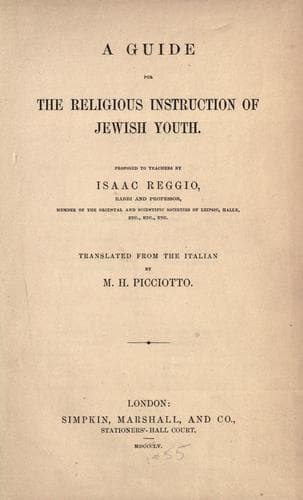
A Guide for the Religious Instruction of Jewish YouthReggio, Isaac Samuel
Religion
A Guide for the Religious Instruction of Jewish Youth
Reggio, Isaac Samuel
Judaism -- Juvenile literature
XLIII. Man also, considered only in his physical nature, is subject to
the universal law of self-love; and until he has arrived at a correct
appreciation of his moral nature and duties, he will allow himself to be
impelled by that law to possess himself of all that he thinks suitable
to his own advantage, regardless of the detriment of others, and even of
their very existence; and so will, on the other hand, every one else,
being in the same condition, act towards him. But the effects of
unrestrained self-love are by far more mischievous in man than in the
irrational animals, for the intelligence with which he is endowed
affords him more means and artifices to accomplish his selfish views, so
long as he is governed by these and not by nobler impulses. Hence it
happens also, that so long as a man lies under the fascination of
self-love, society, of which he is called to become a member, places him
in a condition, from which he looks upon his fellow-men as the natural
enemies of his individual happiness; and he feels a propensity to throw
obstacles, either by malice or violence, in the way of others, to
prevent their attaining that which is denied to him.
XLIV. But we find, also, in man another principle diametrically opposed
to self-love, which, proceeding from the noblest prerogatives of his
soul, distinguishes him from the irrational creatures, and invites him
to a career totally opposite to theirs. This principle, commonly called
virtue, we shall express by the more comprehensive name of _heroism_. As
by self-love man is inclined to sacrifice the welfare of others to his
own, so by heroism he is led to sacrifice himself to the welfare of
others. When we see a mother struggling to death, and with admirable
self-devotion, against overpowering waves, or ferocious beasts, or
devouring flames, to save her child from certain destruction, it would
be stolidity and folly for us to bring into comparison with this act,
the cares bestowed by a brute in feeding her young, since as soon as the
latter has carried into effect the order of nature, she forsakes them,
and, when grown, does not even recognise them; whereas the love of a
mother endures beyond the grave. When a husband, bound with the
indissoluble tie of affection to the woman of his heart, voluntarily
sacrifices to her everything dearest in the world, and finds in her
affection ample recompense for his direst privations, who would dare to
attribute this to the physical sexual tendency common even to the
brutes? a tendency, which, besides manifesting itself only at detached
periods of time, disappears altogether in old age, whereas conjugal love
runs beyond the confines of time. The same may be said of a friend, who
would give his own life to save that of his beloved, of a generous
warrior who risks everything for his country's sake, and of a host of
others, who magnanimously devote themselves to the relief of suffering
humanity; in short, of every one who feels himself moved by a superior
Public-domain text, read in full here on John Shaqi.
Reviews
Reviews
No reviews yet
Be the first to share your thoughts on this work.
Join the Discussion
Join the discussion
Sign in to leave a comment or review.
Sign InorCreate an account