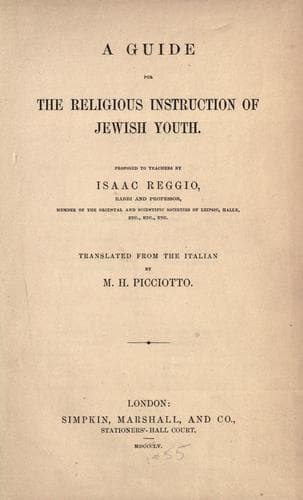
A Guide for the Religious Instruction of Jewish YouthReggio, Isaac Samuel
Religion
A Guide for the Religious Instruction of Jewish Youth
Reggio, Isaac Samuel
Judaism -- Juvenile literature
LXXIX. Among those attributes, however, one becomes prominent, from its
importance; it is that which establishes an immediate relation, or
communion, as subsisting between the Creator and the rational creature;
a fundamental point on which the whole religion hinges. The intimacy of
such a relation manifested itself at the very beginning of the world by
God having created man _in His image_, by which expression it is meant,
that the Divine Maker bestowed some part of His perfections on the
noblest creature on earth, endowing it with intelligence, free-will, and
immortality; these high prerogatives conferred upon man, to a certain
degree, a similitude with his Maker, and from this similitude was
naturally to follow a closer relation of mutual love, than exists
between God and the other created things. Such a relation assumed a more
definite form when God took man under His special guardianship, whilst
He left the government of inanimate nature to physical laws, unalterable
and compulsory, which He had established in the first instant of
creation. The stupendous connection was lastly completed, by God having
communicated His will to men, and traced out to them the course they had
to follow, in order to render themselves worthy of the great boon, and
to attain the end destined for them. From all these circumstances it
became evident that God is _immediate_ to man.
LXXX. As, in general, all the revelation, has for its object to benefit
humanity, so, in particular, when the divine word is directed to impart
to us the knowledge of God, it intends to teach us the duties we are
called upon to fulfil towards the Author of our existence; duties which
we could not well discharge if we were wanting in that knowledge. Now,
the first of these duties is to _love God_. Such a noble feeling, which,
as we have already stated, derives its origin from a relation of
similitude between him who loves and the object beloved, cannot be
kindled in us by effect of a mere command, as the motions of the heart
are not produced by authority. Therefore, while holy writ inculcates the
love of God, it at the same time indicates to us the means whereby this
sublime love will be promoted; and the means is _to walk in the ways of
the Eternal_. To understand the connection between the means and the
end, we must consider the different degrees of which love is
susceptible, and motives by which it is actuated. He who loves God
because of great favours received, is apt to feel a diminution of
attachment, or even indifference, on being overtaken by misfortune. He
who loves Him with a view to benefits in a future life, is also in
danger of ceasing to love, if some doubts were to arise in his mind and
to weaken his hopes. But when man loves God because he understands, and
admires, and adores in Him the aggregate of all perfections, and feels
within himself the flame of a desire to approach the Divine Majesty,
then his love is an inextinguishable love, for he abnegates his own
Public-domain text, read in full here on John Shaqi.
Reviews
Reviews
No reviews yet
Be the first to share your thoughts on this work.
Join the Discussion
Join the discussion
Sign in to leave a comment or review.
Sign InorCreate an account