Produced by Larry B. Harrison and the Online Distributed
Proofreading Team at https://www.pgdp.net
Transcriber's notes: Obvious typographical errors have been
corrected, but otherwise the author's spelling has been preserved.
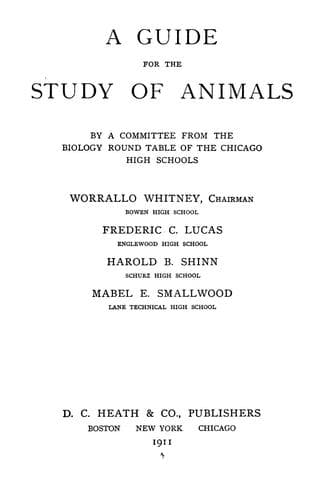
A GUIDE FOR THE
STUDY OF ANIMALS
BY A COMMITTEE FROM THE
BIOLOGY ROUND TABLE OF THE CHICAGO
HIGH SCHOOLS
WORRALLO WHITNEY, Chairman
BOWEN HIGH SCHOOL
FREDERIC C. LUCAS
ENGLEWOOD HIGH SCHOOL
HAROLD B. SHINN
SCHURZ HIGH SCHOOL
MABEL E. SMALLWOOD
LANE TECHNICAL HIGH SCHOOL
D. C. HEATH & CO., PUBLISHERS
BOSTON -- NEW YORK -- CHICAGO
Copyright, 1911,
By D. C. Heath & Co.
1 E 3
PREFACE
The following guide to the study of animals is intended for pupils in
secondary schools. It was prepared by the authors at the request of
the Biology Round Table, an association composed of the teachers of
Biology in the Chicago High Schools, to whom the authors wish to take
this opportunity of expressing their appreciation of the many helpful
suggestions and criticisms of the manuscript.
The time has passed when a high school course in zoölogy consists
simply of a somewhat simplified edition of a similar course in
college. All teachers now recognize that the motivization of any
course should be its adaptability to the needs of the student, and
that zoölogy must be taught from the standpoint of the student rather
than that of the subject. In preparing this guide, the authors have
tried to keep these points in mind.
The matter of presentation, the order of topics, and the choice of
material has been much discussed, but the trend of opinion has
finally set in toward an ecological rather than a type study of
animals; that there should be in the case of young students a brief
study of rather a large number of animals to bring out some general
biological law, rather than an exhaustive study of a very few types.
It is further recognized that the use of a reference library is
absolutely essential in connection with and to supplement the
laboratory work, as there are some topics beyond the ability of the
young student for original investigation as well as impossible in
the amount of time usually allotted to the subject in our crowded
curricula. Of great importance is the economic side of zoölogy,
especially its bearing upon the applied sciences of medicine,
sanitation, household science, and agriculture, and this phase has
received special attention in this guide.
The desirability of field work has always been recognized, but the
special conditions under which schools must work are so variable as
to make any set directions for field work of little value, and so
they have in most cases been omitted in this work. Each teacher can
easily give such special direction for collecting material and study
in the field as the locality of the school and the time available for
it shall determine.
Public-domain text, read in full here on John Shaqi.
Reviews
Reviews
No reviews yet
Be the first to share your thoughts on this work.
Join the Discussion
Join the discussion
Sign in to leave a comment or review.
Sign InorCreate an account