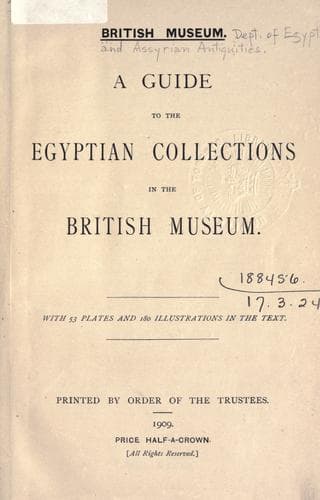
A guide to the Egyptian collections in the British MuseumBritish Museum. Department of Egyptian and Assyrian Antiquities
History
A guide to the Egyptian collections in the British Museum
British Museum. Department of Egyptian and Assyrian Antiquities
Egypt -- Antiquities
The views held by the Egyptians about Osiris from about B.C. 3800 to
the Roman Period may be thus summarized:—=Legend of Osiris.=—Osiris, in
Egyptian ȦSȦR 𓁹𓊨, was once a king who reigned in the south of Egypt; his
sister-wife was called =Isis=, in Egyptian ȦST 𓊨𓏏, and their son Horus,
in Egyptian ḤERU 𓅃. He did great good to all his people, and taught them
the arts of agriculture, and made good laws for them, and ruled them
justly. Now Osiris had a twin brother called =Set= 𓊃𓏏𓈜, the SÊTH of
Plutarch, who was very jealous of him, and who lost no opportunity of
undermining his authority and reviling him, for he wished to see Osiris
removed from his path, so that he might seize his brother’s throne and
wife. At length, by a stratagem, he managed to kill Osiris, by drowning
him in the Nile. The river, however, carried the dead body of Osiris to
the papyrus swamps in the Delta, where the waters deposited it on the
lower branches of an acacia tree, which grew up round it and concealed
it. Isis discovered, by magical means, where her husband’s body was, and
went to the place and took possession of it. Wishing to visit her son
Horus, so that she might urge him to take vengeance on Set, she hid the
body in a secret spot, and went off to the city of Buto to Horus. During
her absence, Set found the body one night when he was out hunting, and
recognizing it, he tore it into fourteen pieces, which he scattered about
the country. Isis, having heard what Set had done, set out and collected
the portions of the body of Osiris, and wherever she found one of them
she buried it, and built a shrine over it.
[Illustration: Osiris rising from the sarcophagus with “life” in each
hand. On each side are two of the children of Horus.]
Now Isis was a great enchantress, and she learned from Thoth the
knowledge of magical ceremonies and of most potent words of power. She
was able to transform herself into any kind of creature, and to travel
through earth, air, fire, or water with equal ease. Instructed by his
mother, Horus, with the assistance of a number of his “followers,”
performed a series of ceremonies connected with the burial of his father,
which had the effect of raising Osiris from the dead, and of establishing
him as king in Ȧmenti, _i.e._, the “Hidden Place,” or the Other World.
When this was done, Osiris appeared to Horus and urged him to avenge him
on Set, and shortly afterwards a great fight between Horus and Set took
place. Set was defeated and, according to the XVIIth Chapter of the Book
of the Dead, mutilated by Horus, who suffered no injury whatsoever. The
great fight took place near the modern city of Asyûṭ, and lasted three
days; each god fought in the form of a wolf or bear. (Fourth Sallier
Papyrus in the British Museum.)
Public-domain text, read in full here on John Shaqi.
Reviews
Reviews
No reviews yet
Be the first to share your thoughts on this work.
Elsewhere in the archive
Join the Discussion
Join the discussion
Sign in to leave a comment or review.
Sign InorCreate an account