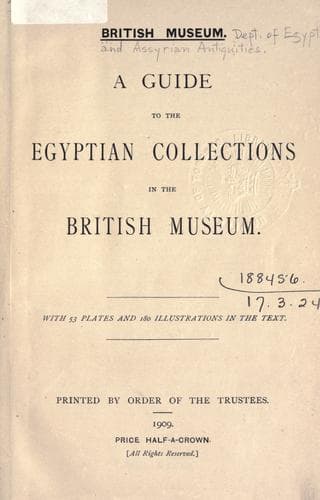
A guide to the Egyptian collections in the British MuseumBritish Museum. Department of Egyptian and Assyrian Antiquities
History
A guide to the Egyptian collections in the British Museum
British Museum. Department of Egyptian and Assyrian Antiquities
Egypt -- Antiquities
In one part of this kingdom was placed the =Judgment Hall of Osiris=,
and there sat the great judge of the dead. The soul of every man was
brought there and weighed in the “Great Balance” in his presence, by
Thoth, the scribe of the gods. The soul was represented by the heart
𓄣, and was weighed against the feather 𓆄, symbolic of righteousness
(_maāt_). If the heart failed to counterbalance the feather it was cast
to an animal monster called Ām-mit, _i.e._, “Eater of the Dead,” which
was part crocodile, part lion, and part hippopotamus. When the heart and
the feather balanced exactly Thoth announced the fact to the gods of his
company, and then the soul of the deceased was taken by Horus into the
presence of Osiris, who rewarded him according to his deserts. Before the
weighing of the heart took place the deceased was obliged, presumably,
to pass along the Hall of Osiris, and to make the =Negative Confession=
before the Two and Forty Assessors of the Dead, “who tried sinners, and
fed upon their blood, on the day when the lives of men are reckoned up in
the presence of the Good Being” (Osiris). Apparently each of these beings
asked him the question: “Hast thou committed such and such a sin”? For
his answers, as given in the Book of the Dead (Chapter CXXV), take these
forms:—
“Hail, Long-strider, coming from Ȧnnu, I have not committed
iniquity.
“Hail, Eater of shades, coming from Qerti, I have not stolen.
“Hail, Bad-face, coming from Re-stau, I have killed neither man
nor woman.
“Hail, Flame, advancing and retreating, I have not robbed God.
“Hail, Uamemti, coming from the house of slaughter, I have not
committed adultery.
“Hail, Two-horns, coming from Saïs, I have not multiplied words
overmuch.”
The =forty-two sins= enumerated in the Negative Confession represent the
chief sins abominated by the Egyptians under the XVIIIth dynasty.
Public-domain text, read in full here on John Shaqi.
Reviews
Reviews
No reviews yet
Be the first to share your thoughts on this work.
Elsewhere in the archive
Join the Discussion
Join the discussion
Sign in to leave a comment or review.
Sign InorCreate an account