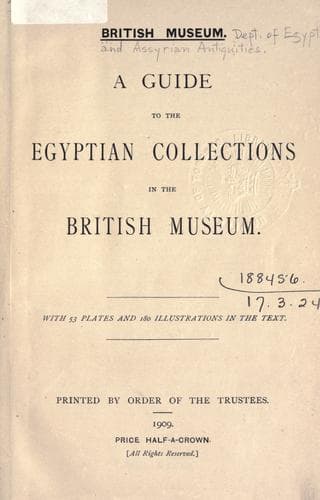
A guide to the Egyptian collections in the British MuseumBritish Museum. Department of Egyptian and Assyrian Antiquities
History
A guide to the Egyptian collections in the British Museum
British Museum. Department of Egyptian and Assyrian Antiquities
Egypt -- Antiquities
The texts connected with the examination of the dead show that the
Egyptian =idea of sin= was different from that of Western nations. With
the Egyptian the commission of sin was regarded merely as a breach of
the ritual law, or of the law of the community, and could be atoned for
by the payment of goods or possessions; this payment once made, the
law-breaker considered that he was free from all obligation, real or
moral. The idea of =repentance= finds no expression in Egyptian texts,
and, curiously enough, there is no word in Coptic for “repentance.” The
translators of the New Testament from Greek into Coptic were obliged to
use the Greek word μετάνοια. From the earliest times the Egyptians appear
to have believed firmly that the righteous would be rewarded in the
Other World, and the wicked punished, but there is no definite statement
on this point in the texts until the XIXth dynasty, when the =doctrine
of retribution= is clearly expressed. In the Second Part of the “Book
of Gates” a number of beings are described as “those who worshipped Rā
upon earth, who spake words of power against the Evil One (Āpep), who
made offerings to Rā, and burnt incense to their own gods.” Other beings
are described as “those who spake truth upon earth, and who did not
approach false gods” 𓈖𓏏𓂋𓇌𓅪𓏥. In return for this Rā gave to them food
and drink which should never fail, and decreed that their souls should
never be hacked in pieces. Close by, in the same section of the work, are
mentioned the “rebels against Rā, who blasphemed the god when they were
upon earth, who thrust aside right, and cursed the god of the horizon.”
As punishment for these deeds Rā decreed that they should be bound in
chains, that their bodies should be cut in pieces, and their souls
destroyed.
Public-domain text, read in full here on John Shaqi.
Reviews
Reviews
No reviews yet
Be the first to share your thoughts on this work.
Elsewhere in the archive
Join the Discussion
Join the discussion
Sign in to leave a comment or review.
Sign InorCreate an account