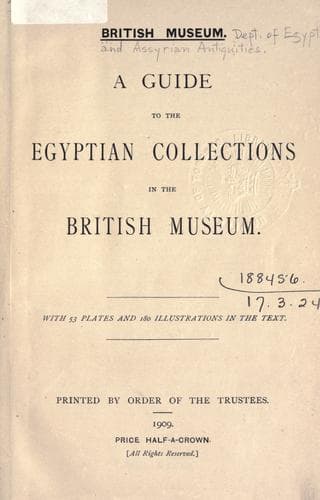
A guide to the Egyptian collections in the British MuseumBritish Museum. Department of Egyptian and Assyrian Antiquities
History
A guide to the Egyptian collections in the British Museum
British Museum. Department of Egyptian and Assyrian Antiquities
Egypt -- Antiquities
In the earliest times heaven was believed to be situated above the large,
flat rectangular slab of iron (or alabaster?) which formed the sky. This
slab was supported on four pillars, which were kept in position and
presided over by the four sons of Horus, Mesthȧ, Ḥāpi, Ṭuamutef, and
Qebḥsennuf. These four gods sat on pillars, which, subsequently, were
regarded as the =four cardinal points=. The stars were believed to be
hung from the slab by hooks through holes, , like lamps from a ceiling.
The righteous ascended to this heaven by means of a ladder. Osiris
himself was obliged to use a ladder, and Horus and Set held each one side
of the ladder [glyph not in Unicode], and assisted him to mount with
their fingers. The models of ladders and of the two forefingers which are
found in tombs commemorate this event.
The name given to the =Other World= was =Ṭuat= 𓇼𓄿𓏏𓉐. This region was
not _under_ the earth, or deep in it, but ran parallel with Egypt, which
formed one side of it. A river flowed through the whole length of it. On
the other side of the river was a range of mountains, and outside this
was the great celestial ocean which surrounded the world. The Ṭuat was a
valley which in the XIXth dynasty was believed to begin near Thebes, at
Manu, the Mountain of Sunset, and, stretching northwards as far as Saïs,
bent round towards the east until it reached the region of Ȧnnu (On),
when it turned to the south and continued until it ended at Bakhet, the
Mountain of Sunrise. The Ṭuat was divided into ten sections, and had a
vestibule at each end of it, and in the XIXth dynasty it included the
local kingdoms of the dead of Thebes, Abydos, Herakleopolis, Memphis,
Saïs, Bubastis, and Ȧnnu. Each section was guarded by a massive gate,
with battlements, but its door flew open before the Sun-god as he
traversed the Ṭuat nightly in his boat. According to one legend there
was a small passage at Abydos called “Peka,” _i.e._, the =Gap=, which
connected this world with the Ṭuat; and according to another there was
a similar passage at Thebes. Be this as it may, the souls of all those
who had died during the day assembled in the passage each evening and
endeavoured to obtain a seat in the solar bark as the god passed by. In
its passage the boat passed the kingdom of Osiris; those who preferred a
material heaven disembarked at that spot, and those who desired to become
like Rā and to be with him remained in their places in the boat. For all
souls, however, there was an examination of their credentials, and those
who were not provided with amulets, and with formulas and words of power,
were ejected.
Public-domain text, read in full here on John Shaqi.
Reviews
Reviews
No reviews yet
Be the first to share your thoughts on this work.
Elsewhere in the archive
Join the Discussion
Join the discussion
Sign in to leave a comment or review.
Sign InorCreate an account