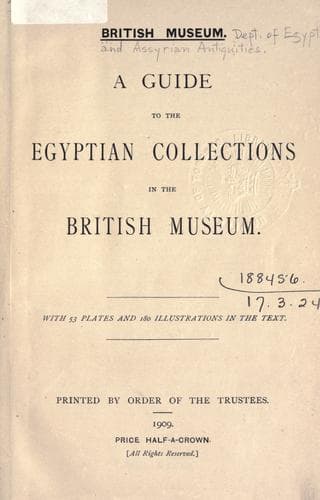
A guide to the Egyptian collections in the British MuseumBritish Museum. Department of Egyptian and Assyrian Antiquities
History
A guide to the Egyptian collections in the British Museum
British Museum. Department of Egyptian and Assyrian Antiquities
Egypt -- Antiquities
The =Steps= 𓊍 symbolized the throne of Osiris, and procured for the
wearer “exaltation” to and in heaven. The =Plumes= symbolized Isis
and Nephthys, who had their seat on the forehead of Rā, and the Maāti
goddesses, or goddesses of Right and Truth. The =Frog= 𓆏 was typical of
teeming life and the resurrection. It was the symbol of the goddess Ḥeqt,
the wife of Khnemu, who made the first man on a potter’s wheel, and when
laid on a dead person transferred to him the new life which was in the
body of the goddess. The =Pesesh-Kef= suggests the idea of second birth
in connexion with the ceremonies of Opening the Mouth. The mouth of
the mummy, or of a statue, was touched with this amulet, or instrument,
whilst the priest recited words of power; as a result of that the mouth
was “opened,” _i.e._, the deceased could henceforth talk, think, walk,
eat, drink, etc., in the Other World. A fine example of this amulet in
flint (Table-case M, Third Egyptian Room) of the Neolithic Period proves
that the idea of “opening the mouth” is older than the dynasties of
Egypt. The =Solar Disk= on the horizon 𓈌 symbolizes life which renews
itself, resurrection, virility, strength, etc. The =Neterui= 𓊋𓑀𓊋𓑀, or 𓊹𓊹,
represent the two iron instruments used in the ceremony of “opening the
mouth”; their presence among the swathings of the mummy, or in the tomb,
secured for the deceased the protection of the gods of the South and the
North.
On rare occasions all the amulets mentioned above have been found
in one tomb, or on a single body. A good example of a collection of
amulets found on a single body is No. 4 (Table-case K, Fourth Egyptian
Room). Here will be seen uraei, the _menȧt_, the _utchat_, the scarab,
the _shen_, the triad of Isis, Nephthys, and Harpokrates: the papyrus
sceptre, the heart, the plumes, the two fingers, ṭeṭs, etc.; the places
on the body on which they were found are indicated by the labels. Another
class of amulets is represented by the figures of gods, goddesses, and
sacred animals, which were either worn as pendants to necklaces, etc.,
during life, or placed among the swathings of the mummified body. Of
these the British Museum possesses very large collections, and the finest
examples of them will be found in Wall-cases Nos. 119-132, in the Third
Egyptian Room. A very remarkable group of amulets or objects, which were
intended to give protection to the tomb of the priestess for whom they
were made, is exhibited in the Second Egyptian Room (Wall-case No. 73).
It consists of a Ṭeṭ 𓊽, a human figure 𓀾, a jackal 𓃣, and a reed, and
each object stands on a small inscribed brick of Nile mud. The ceremony
in which these were used is described in the Book of the Dead (Chapter
CXXXVII). The text is only found in the Papyrus of Nu (No. 10,477), and
the group of objects which illustrates it appears to be unique.
Public-domain text, read in full here on John Shaqi.
Reviews
Reviews
No reviews yet
Be the first to share your thoughts on this work.
Elsewhere in the archive
Join the Discussion
Join the discussion
Sign in to leave a comment or review.
Sign InorCreate an account