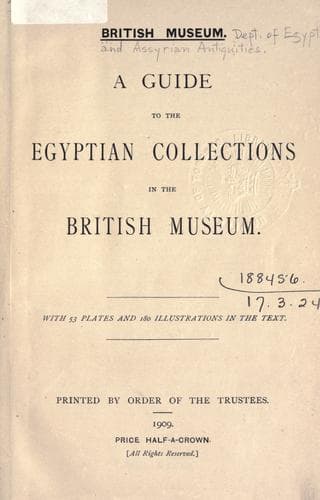
A guide to the Egyptian collections in the British MuseumBritish Museum. Department of Egyptian and Assyrian Antiquities
History
A guide to the Egyptian collections in the British Museum
British Museum. Department of Egyptian and Assyrian Antiquities
Egypt -- Antiquities
In connexion with the numerous ceremonies which found a prominent place
in the cult of Osiris must be mentioned two classes of =magical figures=.
It has already been said that the righteous who lived in the kingdom of
Osiris were employed in the cultivation of the _Maāt_ wheat, on which
both they and Osiris lived. Now, before this wheat could be grown, it
was assumed that the land of the celestial fields had to be prepared
and watered, and renewed with top-dressing, just like the fields on
earth. These laborious agricultural works were performed by a celestial
_corvée_, which was under the general control of the “Ḥenbiu,” or gods of
the Celestial Domain Lands. These gods provided estates for the blessed,
and carefully watched the land measurers to see that they carried out
their orders. They also provided gangs of beings to work these fields,
and set taskmasters (Tchatchaiu) and time-keepers (Kheru āḥāu) over them,
so that they might make them toil their appointed time. Why these beings
were condemned to forced labour cannot be explained, for not a word is
said which would suggest that they were sinners, and that their work was
a punishment. The Egyptian theologians appear to have been incapable of
conceiving a heaven in which there was no _corvée_ to perform menial
tasks, and equally incapable of imagining the existence of a _corvée_
which did not need the constant supervision of time-keepers and gangers.
Be this as it may, the Egyptians, as a people, hated forced labour, and
the priests found a way for them to escape from it. The means chosen was
the =Shabti=, or =Ushabti figure=.[23] The meaning of the word Ushabti is
unknown. Some associate the name with that of the persea tree (=shab=,
or =shabt=), but others connect it with the word =ushab=, “to answer,”
and think the figure was called =Ushabti=, because in the text cut upon
it the figure “answers” and says: “Verily I am there,” etc. The Ushabti
figure was a figure made of wood, stone, porcelain, metal, etc., which
was intended to represent the person on whose behalf it was fashioned,
and it was supposed to carry a digging tool and a basket in which to
remove earth or sand from one place to another. In short, the Ushabti
figure is a model of a farm labourer or _fallâḥ_. On the figure it was
customary to cut a formula which was supposed to be said by the deceased
in the Other World, to this effect: “In the event of my being condemned
to spread dust (_i.e._, _sebakh_ or top-dressing) on the fields in the
Ṭuat, or to fill the water-courses with water from the river, or to reap
the harvest, such work shall be performed for me by thee, and no obstacle
shall be put in thy way.” Below this formula were cut the words with
which the figure was supposed to answer: “Verily I am there, wheresoever
thou mayest speak” (or call me). When the deceased found himself in the
Other World, and condemned to work in the celestial _corvée_, he was
Public-domain text, read in full here on John Shaqi.
Reviews
Reviews
No reviews yet
Be the first to share your thoughts on this work.
Elsewhere in the archive
Join the Discussion
Join the discussion
Sign in to leave a comment or review.
Sign InorCreate an account