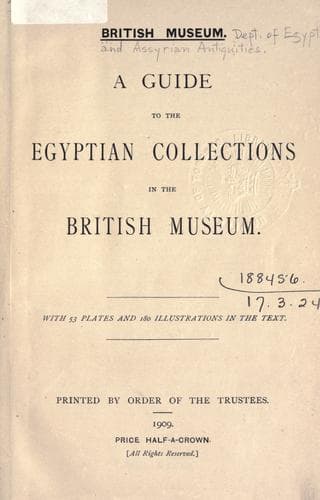
A guide to the Egyptian collections in the British MuseumBritish Museum. Department of Egyptian and Assyrian Antiquities
History
A guide to the Egyptian collections in the British Museum
British Museum. Department of Egyptian and Assyrian Antiquities
Egypt -- Antiquities
We have already seen that, after the murder and mutilation of the body of
Osiris, the Man-god of the primitive Egyptians, by Set, the god of evil,
Horus the son of Osiris, assisted by a number of beings who are called
the =Followers of Horus=, performed a number of magical ceremonies,
whereby the rejoining of the limbs of the god was effected, and the
preservation of his body was secured for ever. The Egyptians argued:
Certain ceremonies were performed by Horus on the dead body of Osiris,
and he was mummified, and as a result he rose from the dead; we therefore
will have the ceremonies which were performed over Osiris performed over
our dead bodies, which shall be mummified, as was the body of Osiris, and
we also shall rise from the dead. Every Egyptian from the time of the
IVth dynasty, about B.C. 3600, believed that his existence in the Other
World depended upon the =mummification= of his body in this world, and
during his lifetime he made provision for his embalmment, and, when his
means permitted, prepared a tomb in which his mummified body should be
placed. Now the Egyptian had several reasons for mummifying the dead: 1.
He wished the souls of the dead to enjoy everlasting life. 2. He wished
to maintain dwelling places for the Kau or “doubles” of the dead, so that
they might not be obliged to wander about in the deserts in search of
food. 3. He wished the dead to form a bond of union between the gods and
himself. 4. He believed that the soul came back to the body from time to
time. 5. He believed in the resurrection of the material body itself,
and that at some future time it would be united to its soul for all
eternity. This last was the chief reason why he preserved the body with
spices, unguents, bitumen, etc., and, in spite of the very high state of
civilization to which the Egyptians attained, the belief in the supreme
importance of mummification was never wholly eradicated from the minds of
ordinary folk, even after they had embraced Christianity.
In the most primitive times the dead were mutilated to prevent their
returning to their native places to live upon the food needed for the
living, but in the Dynastic Period the utmost care was taken to prevent
the mutilation of the body, and to preserve it from destruction caused
by damp, dry rot, or worms. The texts state plainly that after the
resurrection the body was to live upon earth, whilst the soul dwelt in
heaven. In the Vth dynasty it was written: “The soul belongeth to heaven,
and the body to earth,” and in the VIth dynasty it is said to king Pepi:
“Thy essence belongeth to heaven, and thy body belongeth to earth.” The
same idea occurs in all dynasties down to the Ptolemaïc Period, when we
find in the “Lamentations of Isis” the words addressed to the deceased,
who is identified with Osiris: “Heaven hath thy soul, and earth hath thy
body.”
Public-domain text, read in full here on John Shaqi.
Reviews
Reviews
No reviews yet
Be the first to share your thoughts on this work.
Elsewhere in the archive
Join the Discussion
Join the discussion
Sign in to leave a comment or review.
Sign InorCreate an account