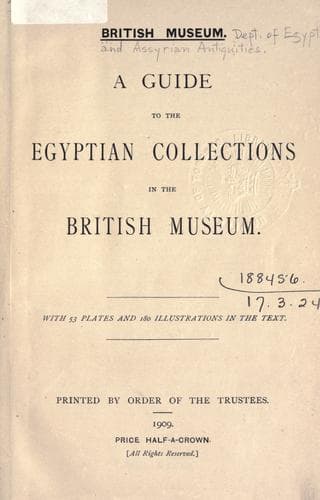
A guide to the Egyptian collections in the British MuseumBritish Museum. Department of Egyptian and Assyrian Antiquities
History
A guide to the Egyptian collections in the British Museum
British Museum. Department of Egyptian and Assyrian Antiquities
Egypt -- Antiquities
Before an account of the process of mummification is given, it will
be well to note briefly the views which the Egyptians held as to the
relationship of the component parts of the material and spiritual man.
Most peoples have divided man into three parts, =body=, =soul=, and
=spirit=; but the Egyptian system of the human economy was more complex.
The material part of a man was the =khat= 𓏏𓐎, or =body=. Through
mummification, and the prayers which were recited over it after that
process, the body obtained a degree of knowledge, and power, and glory,
whereby it became henceforth lasting and incorruptible. This =glorified
body= was called a =Sāḥu= 𓊃𓂝𓎛𓅱𓋩. When a man was born into the world
there was also born with him an abstract individuality, or personality,
which remained with him all the days of his life, and could only be
separated permanently from him by death. To this personality is given
the name =Ka= 𓂓𓏤, a word which has been translated by “double, genius,
image, character, person, self,” etc.
When the Ka left the body at death it was necessary for the living to
find a habitation, and to provide meat, and drink, and shelter for it.
Otherwise it would be obliged to wander about in search of food, and if
it failed to find it, would return and wreak vengeance on the living.
Provision was therefore made for the Ka in the tomb of the dead person
of whom it had once formed a part. First a statue was made in stone, or
wood, and fashioned to represent the deceased. Over this a long series
of ceremonies was performed, and at the end of them the deceased was
declared to have obtained the powers of talking, thinking, walking, etc.,
and the statue was supposed to be in a fit state to receive the Ka should
it be pleased to enter into it and dwell there. A special chamber was set
apart in the tomb for the statue, and through an opening in one of the
walls which communicated with the hall of the tomb wherein the offerings
were made, the Ka inhabiting this statue was able to enjoy the smell of
the incense, meat, wine, and other offerings. It had power to leave the
statue and to wander about at will on earth and in the Other World; and
there are suggestions in the texts that it might take up its abode in the
body of a living man from which his Ka had temporarily gone forth for
some purpose of its own.
Public-domain text, read in full here on John Shaqi.
Reviews
Reviews
No reviews yet
Be the first to share your thoughts on this work.
Elsewhere in the archive
Join the Discussion
Join the discussion
Sign in to leave a comment or review.
Sign InorCreate an account