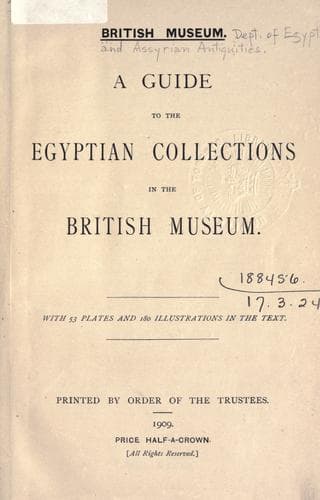
A guide to the Egyptian collections in the British MuseumBritish Museum. Department of Egyptian and Assyrian Antiquities
History
A guide to the Egyptian collections in the British Museum
British Museum. Department of Egyptian and Assyrian Antiquities
Egypt -- Antiquities
The soul was usually accompanied by the =Khaibit= 𓋼𓏤𓏏, or =shadow=,
which may be compared with the σκία of the Greeks, and the _umbra_ of the
Romans. It had an independent existence, and was able to separate itself
from the body at will, but hostile fiends might attack it, and therefore
the deceased prays in the Book of the Dead (Chapter XCII): “Let not be
shut in my soul, let not be fettered my shadow, let a way be opened for
my soul and for my shadow, and let them see the Great God.” It is very
difficult to know where the functions of each of these parts of a man
began and ended, for even the Egyptians became confused in dealing with
them, and the texts often contradict each other. The main facts are,
however, quite clear. The Egyptians believed in the existence of body,
double, spirit, soul, and shadow, at all periods, and the views which
they held about each are best understood by reference to the religious
beliefs which exist at the present time among the A-Zandê, or Nyam-Nyam,
the Bantu, the Mañbattu, and cognate tribes in Central Africa. Under
the influence of foreigners the primitive views became modified as time
went on, but in all essentials the Egyptians who served under the Romans
believed what their ancestors believed 5,000 years before.
CHAPTER VIII.
EMBALMING. THE EGYPTIAN TOMB.
=Mummy= is the name given to the body of a human being, or creature,
which has been preserved from decay by means of spices, gums, natron,
bitumen, etc.; strictly speaking it should only be given to the body
preserved by _bitumen_, for “mummy” is derived from a word which appears
in Arabic under the form _mûmîâ_, and means “bitumen.” The oldest
preserved bodies known were prepared with salt and soda, and bitumen was
certainly not used on a large scale for embalming purposes before the
XXIInd dynasty, about B.C. 900. The embalmed body, swathed in linen, was
called by the Egyptians _qes_ 𓈎𓊃𓀾, 𓈎𓊃𓌟𓍱, or _qesȧu_ 𓈎𓊃𓇋𓅱𓀿𓑀𓍱, which
has passed into Coptic under the form _kôs_. The word “mummy” is not of
Egyptian origin.
Public-domain text, read in full here on John Shaqi.
Reviews
Reviews
No reviews yet
Be the first to share your thoughts on this work.
Elsewhere in the archive
Join the Discussion
Join the discussion
Sign in to leave a comment or review.
Sign InorCreate an account