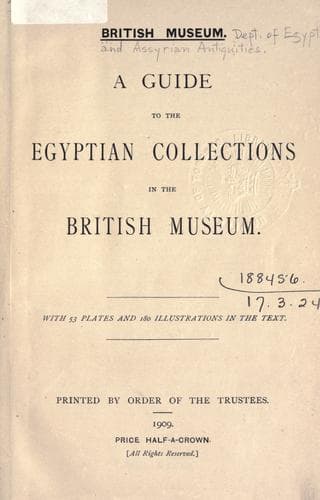
A guide to the Egyptian collections in the British MuseumBritish Museum. Department of Egyptian and Assyrian Antiquities
History
A guide to the Egyptian collections in the British Museum
British Museum. Department of Egyptian and Assyrian Antiquities
Egypt -- Antiquities
In the latter part of the Neolithic Period the Egyptians, in some places
at least, decapitated and dismembered the dead, but subsequently,
probably as a result of change in religious thought, they took steps to
preserve them. At first bodies were merely dried in the sun, and then
placed in a hole in the ground, in a sitting position, just as they
are to this day by the A-Zandê; later they were laid on one side, with
the legs bent upwards, and their knees near the chin. Evisceration of
some kind appears to have been practised, but not of a very elaborate
character. The finest and most complete example of the class of preserved
bodies which were buried in a crouching position is exhibited in the
First Egyptian Room, Case A. Here we see, lying on his left side, a
Predynastic Egyptian, with hair of a reddish tint; the knees are bent
to a level with the top of the breast, and the hands are placed before
the face. He was dolichocephalic, or =long-headed=, and he was both
physically and mentally entirely different from the Dynastic Egyptians,
whose skulls, in respect of measurements, occupy a middle position
between the dolichocephalic and the brachycephalic, or =short-headed=.
Round about the body are vessels which held food, flint weapons, etc. At
this period the body was sometimes wrapped in the skin of some animal, or
rolled up in a reed mat.
Soon after the beginning of the Dynastic Period, probably as the result
of the growth and development of the cult of Osiris, the Egyptians began
to devote more care to the preservation of the bodies of the dead, and
the earliest known examples prove that the brain and viscerae were
removed, and that the placing of bodies in a crouching position in graves
was abandoned, at all events among the ruling classes. The doctrine of
Osiris taught that the human body was a precious thing, and men took care
to embalm it and swathe it in linen, so that it might be ready for the
return of the soul to it, when it would begin a new life in the kingdom
of Osiris.
Public-domain text, read in full here on John Shaqi.
Reviews
Reviews
No reviews yet
Be the first to share your thoughts on this work.
Elsewhere in the archive
Join the Discussion
Join the discussion
Sign in to leave a comment or review.
Sign InorCreate an account