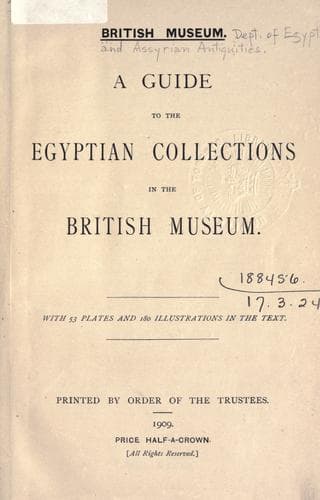
A guide to the Egyptian collections in the British MuseumBritish Museum. Department of Egyptian and Assyrian Antiquities
History
A guide to the Egyptian collections in the British Museum
British Museum. Department of Egyptian and Assyrian Antiquities
Egypt -- Antiquities
The ideas held by the Egyptians concerning the power of the Nile-god are
well illustrated by a lengthy Hymn to the Nile preserved on papyrus in
the British Museum (Sallier II, No. 10,182). “Homage to thee, O Ḥāpi,
thou appearest in this land, and thou comest in peace to make Egypt
to live. Thou waterest the fields which Rā hath created, thou givest
life unto all animals, and as thou descendest on thy way from heaven
thou makest the land to drink without ceasing. Thou art the friend of
bread and drink, thou givest strength to the grain and makest it to
increase, and thou fillest every place of work with work.... Thou art
the lord of fish ... thou art the creator of barley, and thou makest the
temples to endure for millions of years.... Thou art the lord of the
poor and needy. If thou wert overthrown in the heavens, the gods would
fall upon their faces, and men would perish. When thou appearest upon
the earth, shouts of joy rise up and all people are glad; every man of
might receiveth food, and every tooth is provided with meat.... Thou
fillest the storehouses, thou makest the granaries to overflow and thou
hast regard to the condition of the poor and needy. Thou makest herbs
and grain to grow that the desires of all may be satisfied, and thou art
not impoverished thereby. Thou makest thy strength to be a shield for
man.” Elsewhere he is called the “father of the gods of the company of
the gods who dwell in the celestial ocean,” and he was declared to be
self-begotten, and “One,” and in nature inscrutable.
In another passage of the same hymn it is said that the god is not
sculptured in stone, that images of him are not seen, “he is not to
be seen in inscribed shrines, there is no habitation large enough to
contain him, and thou canst not make images of him in thy heart.” These
statements suggest that statues or figures of the Nile-god were not
commonly made, and it is a fact that figures of the god, large or small,
are rare. In the fine collection of figures of Egyptian gods exhibited
in the Third Egyptian Room, which is certainly one of the largest in
the world, there is only one figure of Ḥāpi (No. 108, Wall-case 125).
In this the god wears on his head a cluster of papyrus plants 𓇇, before
which is the Utchat, or Eye of Horus, 𓂀, and he holds an altar from which
he pours out water. The only other figure of the god in the British
Museum collection is the fine quartzite sandstone statue (Southern
Egyptian Gallery, No. 766) which was dedicated to Ȧmen-Rā by Shashanq,
the son of Uasarken and his queen Maāt-ka-Rā. Here the god bears on his
out-stretched hands an altar, from which hang down bunches of grain,
green herbs, flowers, waterfowl, etc. The statue was dedicated to
Ȧmen-Rā, who included the attributes of Ḥāp among his own.
[Illustration: The NILE from SEA to SOURCE]
Public-domain text, read in full here on John Shaqi.
Reviews
Reviews
No reviews yet
Be the first to share your thoughts on this work.
Join the Discussion
Join the discussion
Sign in to leave a comment or review.
Sign InorCreate an account