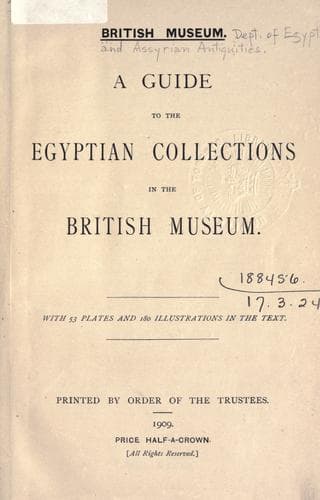
A guide to the Egyptian collections in the British MuseumBritish Museum. Department of Egyptian and Assyrian Antiquities
History
A guide to the Egyptian collections in the British Museum
British Museum. Department of Egyptian and Assyrian Antiquities
Egypt -- Antiquities
The linen =mummy swathings= must now be mentioned. These were made from
=flax=, and were of various thicknesses. Surviving examples vary in
length from a few inches to about 15 feet, and in width from 2 to 10
inches; some are made with fringe at each end. Mummies are often found
wrapped in linen sheets, several feet square, and the outside covering
of all is sometimes of a purple or salmon colour. Under the Ancient
Empire, mummy swathings were quite plain, but under the Middle Empire,
blue stripes occasionally appear at the ends, and the sheets in which
the mummies of kings were wrapped, _e.g._, Ȧmenḥetep III and Thothmes
III, were covered with hieroglyphic texts from the Book of the Dead. At
a later period texts in the hieratic character appear on the swathings,
accompanied by vignettes drawn in outline. The principal seat of the
linen industry in Egypt was Panopolis, the modern Akhmîm, and, at a very
early period, the weavers attained to such skill, that in a square inch
540 threads may be counted in the warp and 110 in the woof. About the
third century of our era, the mummies of wealthy people were wrapped in
“royal cloth” made wholly of silk and decorated with figures of gods,
animals, etc. The visitor will find a large collection of mummy swathings
and sheets exhibited in Table-case E, in the Third Egyptian Room. Here
are the fringed linen =winding-sheet= of Teḥuti-sat, a singing woman of
Queen Ȧāḥmes-nefert-ȧri, B.C. 1550 (No. 1); two swathings inscribed with
texts from the Book of the Dead (Nos. 11, 12); a roll of linen inscribed
with the names of Piānkhi Seneferef-Rā, B.C. 700 (No. 13); grave shirts
from Akhmîm (Nos. 18-27); and specimens of =embroidered linen=, with
figures of saints, etc. (No. 39 ff.); a portion of a =Coptic stole=
embroidered with scenes from the life of Christ, and squares of linen
worked with coloured figures of birds (doves?), and the Cross and symbol
of “life” 𓋹 within wreaths (Nos. 40-51).
Public-domain text, read in full here on John Shaqi.
Reviews
Reviews
No reviews yet
Be the first to share your thoughts on this work.
Elsewhere in the archive
Join the Discussion
Join the discussion
Sign in to leave a comment or review.
Sign InorCreate an account