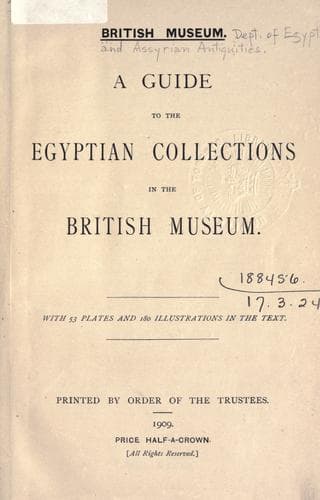
A guide to the Egyptian collections in the British MuseumBritish Museum. Department of Egyptian and Assyrian Antiquities
History
A guide to the Egyptian collections in the British Museum
British Museum. Department of Egyptian and Assyrian Antiquities
Egypt -- Antiquities
The Egyptians, even after their conversion to Christianity, continued for
a time to mummify their dead, and to bury them with the old ceremonies;
but before the end of the third century A.D. the art of embalmment had
fallen into general disuse. The pagan Egyptian embalmed his dead because
he believed that the “perfect soul” would return to the body after
death, and that it would enter upon a new life in it; he therefore took
pains to preserve the body against the corruption of the grave. The
Christian Egyptian believed that at the Resurrection he would receive
back his body, changed and incorruptible, and that it was unnecessary
for him to preserve by means of spices and unguents that which he would
obtain, without any trouble on his part, by faith through Christ. Little
by little, as a result of this belief, the observance of the old pagan
ceremonies ceased, and with them embalmment in the Egyptian fashion. The
views which Anthony the “Father of the Monks of the Egyptian desert”
(A.D. 250-355), held on this matter are of importance. According to
Athanasius: “The Egyptians were in the habit of taking the dead bodies
of righteous men, and especially those of the blessed martyrs, and of
embalming them and placing them, not in graves, but on biers in their
houses, for they thought that by so doing they were paying honour to
them.” Anthony besought the Bishops to preach to the people, and to
command them to cease from this habit, and he showed “That it was a
transgression of a command for a man not to hide in the ground the bodies
of those who were dead, even though they were righteous men. Therefore
many hearkened and were persuaded not to do so, and they laid their dead
in the ground, and buried them therein.” When he was dying he entreated
his monks, saying: “Permit no man to take my body and carry it into
Egypt, lest according to the custom which they have, they embalm me
and lay me up in their houses.... And ye know that I have continually
made exhortation concerning this thing and begged that it should not be
done, and ye well know how much I have blamed those who observed this
custom. Dig a grave then, and bury me therein, and hide my body under the
earth, and let these my words be observed carefully by you, and tell ye
no man where ye lay me until the Resurrection of the Dead, when I shall
receive this body without corruption from the Saviour.” (See _The Life of
Anthony, by Athanasius_, in Migne _Patrologiae_, Ser. Graec., tom. XXVI,
col. 972.)
Public-domain text, read in full here on John Shaqi.
Reviews
Reviews
No reviews yet
Be the first to share your thoughts on this work.
Elsewhere in the archive
Join the Discussion
Join the discussion
Sign in to leave a comment or review.
Sign InorCreate an account