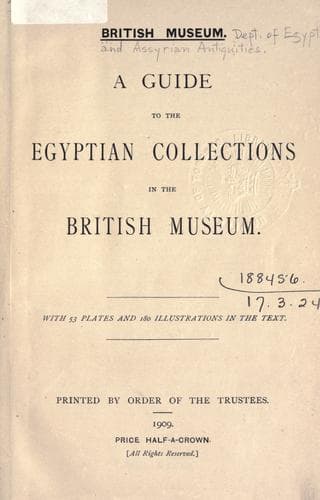
A guide to the Egyptian collections in the British MuseumBritish Museum. Department of Egyptian and Assyrian Antiquities
History
A guide to the Egyptian collections in the British Museum
British Museum. Department of Egyptian and Assyrian Antiquities
Egypt -- Antiquities
[Illustration: The soul, in the form of a human-headed bird, descending
the pit of the tomb to visit the mummy in the mummy chamber.]
The interior of the complete maṣṭaba consists of: 1. A chamber. 2. The
Serdâb. 3. A pit. 4. A mummy-chamber. The walls of the =maṣṭaba chamber=
may be ornamented with sculptures or not. In it, facing the east, is a
false door, which is usually inscribed. At the foot of the false door, on
the bare ground, is often seen a =tablet for offerings=, made of granite,
alabaster, limestone, etc., on which are sculptured figures of meat and
drink offerings—cakes, loaves of bread, geese, a haunch of beef, vases of
unguents, fruit, vegetables, flowers, etc. In many tablets for offerings
small tanks, or hollows, with channels, are cut, and in these libations
of wine were supposed to be poured. A large collection of such tablets
for offerings of all periods, from the IVth dynasty to the Roman Period,
is exhibited in the Egyptian Gallery, Bays 14 and 16. Sometimes a pair of
stands for offerings, made of stone, is found by the stele; examples of
these are exhibited in Wall-case No. 200, in the Fourth Egyptian Room.
In the south or north wall of the maṣṭaba chamber is usually a narrow
chamber built of large stones, partly hidden in the masonry, to which the
name of =Serdâb=[25] has been given. Sometimes the serdâb is isolated
from the chamber, but usually it is connected with it by means of a
rectangular passage, or slit, so narrow that the hand can be inserted
in it with difficulty. Inside the serdâb the statue of the deceased,
which was intended to serve as a dwelling-place for the Ka, or double,
was placed, and the passage was made in order to conduct to it the smoke
and smell of the burning incense and offerings. The serdâb is sometimes
called the “Ka-chapel,” and persons of means and position generally
appointed a “priest of the Ka” to offer up offerings morning and evening.
The =pit=, or =shaft=, of the maṣṭaba was rectangular, square, or oblong,
but never round, and it varied in depth from 40 to 80 feet. It led to
the chamber below the ground where the mummy was laid. At the bottom
of the pit, on the south side, was an opening into a passage from 4 to
5 feet high; this passage led obliquely to the south-east, in the same
direction as the upper chamber, and then expanded on all sides and became
the sarcophagus chamber, or =mummy chamber=. When the dried or mummified
body had been placed in the sarcophagus, and the cover of the sarcophagus
had been sealed, the pit was filled with stones, mud, and sand, and the
deceased was thus preserved from all ordinary chances of disturbance.
Public-domain text, read in full here on John Shaqi.
Reviews
Reviews
No reviews yet
Be the first to share your thoughts on this work.
Elsewhere in the archive
Join the Discussion
Join the discussion
Sign in to leave a comment or review.
Sign InorCreate an account