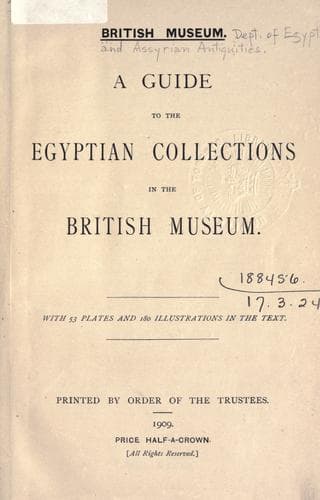
A guide to the Egyptian collections in the British MuseumBritish Museum. Department of Egyptian and Assyrian Antiquities
History
A guide to the Egyptian collections in the British Museum
British Museum. Department of Egyptian and Assyrian Antiquities
Egypt -- Antiquities
The =ornamentation of the maṣṭaba= consisted of sculptured scenes of
three classes: 1. Biographical. 2. Sepulchral. 3. Those referring to
the cult of the dead and funerary gifts. In them we see the deceased
hunting, fishing, making pleasure excursions by water, listening to
music and watching women dance, overseeing building operations, or the
work of ploughing, sowing and reaping on his estate, the management of
cattle, the bringing of offerings to his tomb, etc. The reader will
gain a good idea of the general arrangement of the false doors inside
the maṣṭaba chamber, and the painted decorations and sculptures of an
ordinary maṣṭaba, by examining the complete monument exhibited in the
Assyrian Saloon. This was built originally on the side of a small spur
of the mountain near Ṣaḳḳârah for Ur-ȧri-en-Ptaḥ, a royal scribe and
councillor who flourished in the reign of Pepi II Nefer-ka-Rā, about
B.C. 3100. It is interesting to note that two “false doors” are found on
the south wall of this maṣṭaba, one for Ur-ȧri-en-Ptaḥ and one for his
wife Khent-kaut-s, and that the former contains a list of names of about
ninety canonical offerings. The decorations of maṣṭabas never include
figures of gods, or the emblems which at a later period were considered
sacred.
The next form of the tomb was the =pyramid=,[26] which is to all intents
and purposes merely a maṣṭaba built on a square base, with the greater
part of it above the surface of the ground. It contained a long passage,
with a sarcophagus chamber, or mummy chamber, at the end of it. The
place of the maṣṭaba chamber was taken by a small temple, or chapel,
built outside the pyramid, in which funerary gifts and offerings were
made; the pit of the maṣṭaba was represented by a long passage, which
sloped either upwards or downwards; and the mummy-chamber in each case
was substantially the same. The principal pyramids of Egypt are those of
Abû Roâsh, Gîzah, Zâwyet al-ʿAryân, Abû-Ṣîr, Ṣaḳḳârah, Lisht, Dahshûr,
Al-Lâhûn, Ḥawârah, and Kulla. In the Egyptian Sûdân there are pyramids at
Kurrû, Zûma, Tanḳâsi, Gebel Barkal, Nûrî, and Bagrawîr, but all these are
inferior in design and construction to the pyramids of Egypt. The latest
of the pyramid tombs in the Sûdân were built probably during the first
or second century A.D. by a series of native queens, each of whom bore
the name of “Candace.” A great many theories, chiefly of an astronomical
character, have been formulated about the Pyramids of Gîzah: but it is
now generally thought that they were tombs and nothing else, and there is
no evidence to justify us in believing that they were built by any of
the Hebrew patriarchs, or that they were the “Granaries of Joseph,” or
that they contain chambers filled with gold and precious stones, which
have not yet been discovered or cleared out. The kings of the XIIth
dynasty followed the example of their predecessors of the Vth and VIth
dynasties, and built pyramids for their tombs, but they were on a much
Public-domain text, read in full here on John Shaqi.
Reviews
Reviews
No reviews yet
Be the first to share your thoughts on this work.
Elsewhere in the archive
Join the Discussion
Join the discussion
Sign in to leave a comment or review.
Sign InorCreate an account