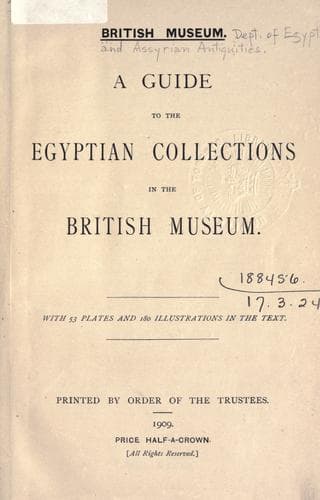
A guide to the Egyptian collections in the British MuseumBritish Museum. Department of Egyptian and Assyrian Antiquities
History
A guide to the Egyptian collections in the British Museum
British Museum. Department of Egyptian and Assyrian Antiquities
Egypt -- Antiquities
=Chronology=, and the =ancient Egyptian Year=. The Calendars of Lucky
and Unlucky Days indicate that in very early times the Egyptian Year
consisted of 12 months each of 30 days, _i.e._, that the primitive year
contained 360 days. Whether the Egyptians ever tried to use the lunar
year of 354 days there is no evidence to show. Now the progress of the
seasons would, in a few years, soon convince those who used the =year=
of =360 days= that their year did not agree with the solar year, and
that it was too short, and they would be obliged to add to its days in
some way. The inscriptions prove that even at so early a period as the
reign of Pepi II of the VIth dynasty, the Egyptians were in the habit of
adding =five days= each year to their year of 360 days, and that before
B.C. 3000 the year in common use contained =365 days=. These “five days”
are known as “the days over the year” 𓆳𓁷𓂋𓅱𓇳𓐃, or 𓇳𓏦𓏾𓁷𓂋𓅱𓇯𓏥𓆳𓏏𓏤,
or “the =five epagomenal days=,” and they were said to be the days on
which Osiris, Horus, Set, Isis, and Nephthys respectively were born. The
primitive year of 360 days was divided into =three seasons=. The first
season was =Shat=, or =Akhet=, 𓆷𓏏𓇳; it began about July 19 and ended
about November 15, and corresponded practically with the period of the
Inundation. The second season was =Pert= 𓉐𓂋𓏏𓇳; it began about November
15 and ended about March 15. The third season was =Shemu= 𓈚𓈗; it began
about March 15 and ended about July 13. These seasons to the Egyptians
represented roughly =Winter=, =Spring=, and =Summer=. Each season
contained =four months=, which were in early times called the first,
second, third, and fourth month of that season; in later times a name was
given to each month. The following was the early calendar:—
COPTIC NAME.[27]
𓇺𓏺𓆷𓏏𓇳, 1st Month of sowing THOTH. ⎫
𓇺𓏻𓆷𓏏𓇳, 2nd ” ” PAOPHI. ⎪ Inundation time
𓇺𓏼𓆷𓏏𓇳, 3rd ” ” ATHYR. ⎪ and Winter.
𓇺𓏽𓆷𓏏𓇳, 4th ” ” CHOIAK. ⎭
𓇺𓏺𓉐𓂋𓏏𓇳, 1st Month of growing TYBI. ⎫
𓇺𓏻𓉐𓂋𓏏𓇳, 2nd ” ” MECHIR. ⎪ Spring.
𓇺𓏼𓉐𓂋𓏏𓇳, 3rd ” ” PHAMENOTH. ⎪
𓇺𓏽𓉐𓂋𓏏𓇳, 4th ” ” PHARMUTHI. ⎭
𓇺𓏺𓈚𓈗[28], 1st Month of inundation PACHONS. ⎫
𓇺𓏻𓈚𓈗, 2nd ” ” PAYNI. ⎪ Summer.
𓇺𓏼𓈚𓈗, 3rd ” ” EPIPHI. ⎪
𓇺𓏽𓈚𓈗, 4th ” ” MESORE. ⎭
Public-domain text, read in full here on John Shaqi.
Reviews
Reviews
No reviews yet
Be the first to share your thoughts on this work.
Elsewhere in the archive
Join the Discussion
Join the discussion
Sign in to leave a comment or review.
Sign InorCreate an account