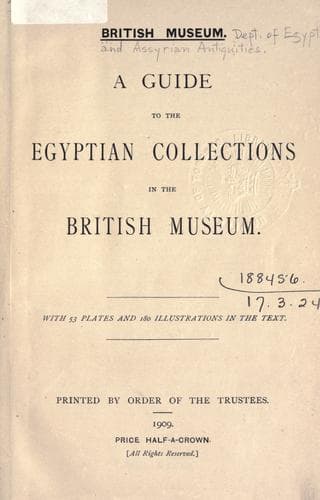
A guide to the Egyptian collections in the British MuseumBritish Museum. Department of Egyptian and Assyrian Antiquities
History
A guide to the Egyptian collections in the British Museum
British Museum. Department of Egyptian and Assyrian Antiquities
Egypt -- Antiquities
To these twelve months, as already said, five days were added, and the
year thus formed is generally known as the “=vague= (or wandering)
=year=,” and the “=calendar year=.” Now it is clear that since this vague
year of 365 days was shorter than the true year, or “=solar year=,” of
365¼, by nearly a quarter of a day, every fourth vague year would be
shorter than the true year by nearly a whole day. Moreover, given a
sufficient number of years, the vague year would work backward through
all the months of the year, until at length the first day of the vague
year would coincide with the first day of the solar year. Thus, supposing
the first day of the vague and solar years to have coincided on January
1, B.C. 2000, two hundred years later the first day of the vague year
would have worked back about 50 days; and five hundred years later,
_i.e._, about B.C. 1300, the first day of the vague year would fall in
the height of the summer instead of in the depth of winter. This defect
in their year of 365 days would soon become apparent, and we may be
sure that they were not long in discovering some means for correcting
it. According to some authorities the Egyptians knew the length of the
true, or solar, year with considerable exactitude, and if this be so they
were well able to plan their farming operations without any reference
to the vague year. According to others the Egyptians were ignorant of
the solar year, but were acquainted with a =Sothic year=, which is so
called because it began on the day when the star =Sepṭ= (or =Sirius=,
or =Sothis=, or the =Dog Star=) rose heliacally, that is to say, with
the sun. This happened on July 19 or 20, and as this date was very near
the time when the Inundation began, the Egyptians considered it most
convenient for their year and the Inundation to begin at the same time.
The =Sothic year= contained practically 365¼ days, _i.e._, a few minutes
more than the true, or solar, year; and the =Sothic Period=, _i.e._,
the length of the time which must elapse between two risings of Sothis
heliacally, contained 1,460 Sothic years, or 1,461 vague, or calendar,
years.
Public-domain text, read in full here on John Shaqi.
Reviews
Reviews
No reviews yet
Be the first to share your thoughts on this work.
Elsewhere in the archive
Join the Discussion
Join the discussion
Sign in to leave a comment or review.
Sign InorCreate an account