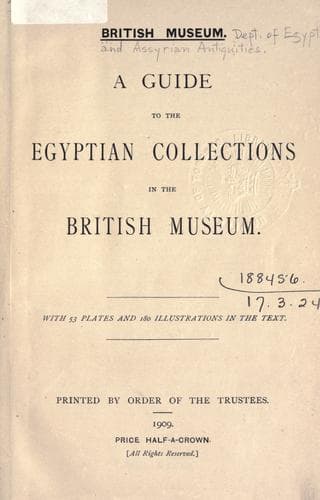
A guide to the Egyptian collections in the British MuseumBritish Museum. Department of Egyptian and Assyrian Antiquities
History
A guide to the Egyptian collections in the British Museum
British Museum. Department of Egyptian and Assyrian Antiquities
Egypt -- Antiquities
=Senṭ= or =Senṭȧ= is mentioned in connexion with a certain medical work
which was either written or edited in the reign of Semti, the fifth king
of the Ist dynasty. Nothing is known of Senṭ’s reign, but we find from
the tomb of =Sherȧ=, a priest, that services were performed on behalf
of his Ka or “Double” and that of his predecessor Perȧbsen. Sherȧ the
priest probably lived at the end of the IInd, or at the beginning of the
IIIrd, dynasty. A fine slab from his tomb is exhibited in the Egyptian
Vestibule, No. 1.
Of the remaining kings of the IInd dynasty, =Neferkarā=, =Neferkaseker=,
=Ḥetchefa=, and =Bebi=, or =Tchatchai=, their names only have survived.
Third Dynasty. From Memphis.
_About_ B.C. 3966.
The greatest of the kings of this dynasty was =Tcheser=, or =Tcheser-sa=,
who is renowned as the builder of the famous =Step Pyramid= at Ṣaḳḳârah.
This pyramid is about 200 feet high, and has six “steps,” 38, 36, 34½,
33, 31, and 29½ feet high respectively; the lengths of its sides at the
base are: north and south, 352 feet, east and west 396 feet. A tomb of
Tcheser, who has been identified with this king, was discovered at Bêt
Khallâf in 1901. Details of his reign are wanting, but, according to a
legend preserved on a rock stele on the Island of Sâḥal in the First
Cataract, a =Seven Years’ Famine= came upon Egypt in his time, and want
and misery were universal. Greek tradition ascribed to Tcheser great
medical knowledge, and he is said to have been a patron of literature.
Among the objects of this king in the British Museum may be mentioned
the fragment of a slate vase (Table-case L, No. 169), and the very
interesting small =glazed tiles= (Nos. 208, 209, in the same case; and
see Table-case K in the Fourth Egyptian Room, Nos. 863-869), which were
found inlaid in the wall of the doorway in the pyramid of King Tcheser.
Public-domain text, read in full here on John Shaqi.
Reviews
Reviews
No reviews yet
Be the first to share your thoughts on this work.
Elsewhere in the archive
Join the Discussion
Join the discussion
Sign in to leave a comment or review.
Sign InorCreate an account