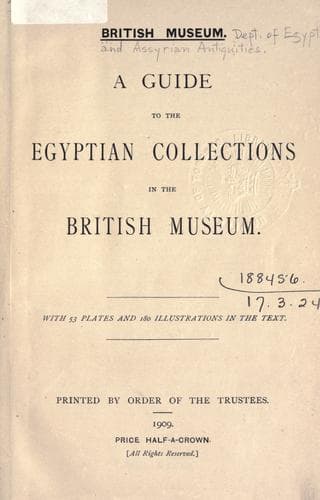
A guide to the Egyptian collections in the British MuseumBritish Museum. Department of Egyptian and Assyrian Antiquities
History
A guide to the Egyptian collections in the British Museum
British Museum. Department of Egyptian and Assyrian Antiquities
Egypt -- Antiquities
Khufu was succeeded by =Ṭeṭ-f-Rā=, of whom nothing is known; and he again
was succeeded by =Khā-f-Rā=, the =Chephren= of the Greek writers, who is
famous chiefly as the builder of the =Second Pyramid= at Gîzah, called in
Egyptian “Ur” 𓅨𓉴, _i.e._, the “Great.” Its height is about 450 feet, the
length of each side at the base is 700 feet, and it is said to contain
about 60,000,000 cubic feet of masonry, weighing some 4,883,000 tons.
It was first opened by Belzoni (born 1778, died 1823) in 1816. It was
originally cased with polished stone, but only towards the top has the
casing been preserved. The illustration on page 171 shows the arrangement
of the corridor and sarcophagus chamber, which is very different from
that of the Great Pyramid. A funerary chapel was attached to the pyramid;
and among those who ministered in it was =Rutchek=, the chief of the
libationer priests, who calls himself a “friend of Pharaoh” 𓋴𓍋𓈖𓉐𓉻. (For
an architrave and an inscription from his tomb see Egyptian Vestibule,
Nos. =22= and =23=.) The Pyramid itself was in charge of the “royal
kinsman” =Thethȧ=, who was the royal steward, and “overseer of the
throne of Pharaoh,” and priest of Hathor and Neith. Two fine doors from
the maṣṭaba tomb of Thethȧ are exhibited in the Northern Egyptian Gallery
(Bay 1, Nos. =24= and =25=), together with a short inscription referring
to the burial of his father and mother (No. =26=). The perfection to
which the sculptor’s art had attained at this period is well illustrated
by the casts of =statues= of =Chephren=, from the hard stone originals in
the Museum in Cairo, exhibited in the Egyptian Vestibule, Nos. =27= and
=28=. A fragment of an alabaster vessel from the king’s tomb, bearing his
name, is in Wall-case 138 in the Fourth Egyptian Room, No. 56.
[Illustration: King Menkaurā (Mykerinos).
[Vestibule, South Wall, No. 30.]]
Public-domain text, read in full here on John Shaqi.
Reviews
Reviews
No reviews yet
Be the first to share your thoughts on this work.
Elsewhere in the archive
Join the Discussion
Join the discussion
Sign in to leave a comment or review.
Sign InorCreate an account