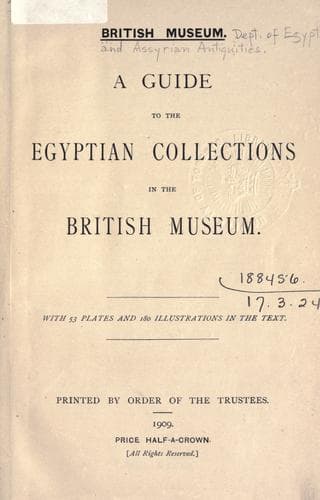
A guide to the Egyptian collections in the British MuseumBritish Museum. Department of Egyptian and Assyrian Antiquities
History
A guide to the Egyptian collections in the British Museum
British Museum. Department of Egyptian and Assyrian Antiquities
Egypt -- Antiquities
=Ȧssȧ=, the next king of importance, worked the quarries in Wâdî
Ḥammâmât, near the old high road which ran from Ḳena on the Nile, in
Upper Egypt, to a place near the modern Ḳuṣêr (Cosseir) on the Red Sea,
and the copper and turquoise mines in the Peninsula of Sinai. He built
at Abû-Ṣîr the pyramid called “Nefer” 𓄤𓉴. During the reign of Ȧssȧ a
development of trade between Egypt and the Sûdân ensued, and an Egyptian
official called Ba-ur-ṭeṭ succeeded in reaching the “Land of the Spirits”
and bringing thence a pygmy _ṭenḳ_ 𓂧𓈖𓎼𓄔𓁌, whom he gave to the king. The
pygmy actually came from the land of Punt, which tradition declares was
the original home of the Egyptians. He was employed to dance the “dance
of the gods” before the king. It seems to have been the custom in still
earlier times to import pygmies from the Sûdân, for skeletons of two were
found near the tomb of Semempses, a king of the Ist dynasty, at Abydos.
=Unȧs=, the last king of the Vth dynasty, the Onnos of Manetho, carried
on the usual mining operations, and, it is said, built a temple to Hathor
at Memphis. He is chiefly famous as the builder of the first of a very
remarkable series of pyramids at Ṣaḳḳârah, the corridors and chamber
walls of which were covered with series of formulae of the greatest value
for the study of the Egyptian Religion. The pyramid of Unȧs was about
60 feet high, and the length of each side at the base was 220 feet; in
front of its door stood a portico which rested on granite columns with
palm-leaf capitals. One of these columns now stands in the Egyptian
Vestibule, No. =50=. (For an alabaster vase from his mummy chamber,
inscribed with his name and titles 𓍹𓅭𓇳𓃹𓈖𓇋𓋴𓍺, see Wall-case 138 in the
Fourth Egyptian Room, No. 57.)
The funerary reliefs of the Vth dynasty are very fine. Those worthy of
note are: a “false door,” from the tomb of =Khnemu-ḥetep=, a councillor
and libationer and an officer of the palace of =Userkaf= (Egyptian
Vestibule, No. =51=); a portion of the façade of the tomb of =Neka-ānkh=,
a priest who ministered in the tomb of =Userkaf= (No. =52=); a massive
“false door” from the tomb of =Ȧsȧ-ānkh=, from Ṣaḳḳârah (No. =53=);
a slab sculptured in low relief with a figure of the royal kinswoman
=Thethȧ= (No. =60=); and a slab from the tomb of =Khnemu-ḥetep=, a chief
of Nekheb (No. =61=).
Sixth Dynasty. From Memphis.
_About_ B.C. 3300.
The kings of this dynasty were:—
1. =Tetȧ.=
2. =Userka-Rā.=
3. =Rā-meri Pepi I.=
4. =Mer-en-Rā.=
5. =Nefer-ka-Rā Pepi II.=
6. =Mer-en-Rā Tchefau(?)-em-sa-f.=
Public-domain text, read in full here on John Shaqi.
Reviews
Reviews
No reviews yet
Be the first to share your thoughts on this work.
Elsewhere in the archive
Join the Discussion
Join the discussion
Sign in to leave a comment or review.
Sign InorCreate an account