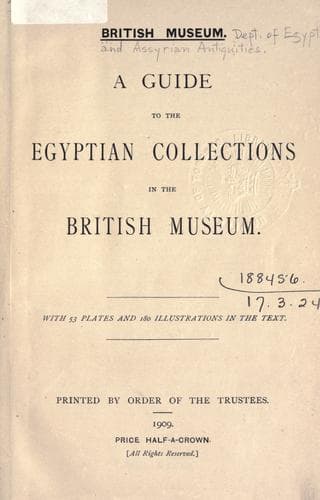
A guide to the Egyptian collections in the British MuseumBritish Museum. Department of Egyptian and Assyrian Antiquities
History
A guide to the Egyptian collections in the British Museum
British Museum. Department of Egyptian and Assyrian Antiquities
Egypt -- Antiquities
=Tetȧ=, the first king of this dynasty, was neither a warrior nor a great
builder; and details of his reign are wanting. He built a pyramid at
Ṣaḳḳârah, the interior of the chambers and corridors of which are covered
with inscriptions of a religious character; it is commonly known as the
“Prison Pyramid.” Of the monuments of this king in the British Museum
may be mentioned a =grant of land= to the god Khenti Ȧmenti of Abydos
(Egyptian Vestibule, No. =74=); an alabaster =vase= from his pyramid,
inscribed with his name and titles (Wall-case 138 in the Fourth Egyptian
Room, Nos. 59 and 60); and a fine breccia =bull=, to which the royal
names and titles have been added in recent times (No. 61).
Rā-meri, =or Pepi I=, was probably the greatest king of this dynasty.
He worked the granite quarries at Elephantine, or Syene, and in the
Wâdî Ḥammâmât, and he established his power in the Peninsula of Sinai,
where he ruled the local tribes with a strong hand. His reign was one of
industrial progress; and trade and handicrafts flourished throughout the
country under his fostering care. Under the leadership of a favourite
official named =Unȧ=, he despatched a very large army composed of men
drawn from all parts of the Sûdân, to put down a wide-spread revolt which
had broken out among the dwellers in the Eastern Desert called “the Āamu,
who lived on the sand.” Unȧ gained a decisive victory, and was promoted
to very high honours. Pepi I built a pyramid at Ṣaḳḳârah, the walls of
the chambers and corridors of which were covered with inscriptions of a
religious character; from this comes the fine alabaster =vase=, inscribed
with his name and titles, in Wall-case 138 in the Fourth Egyptian Room,
No. 66. (For two fine “false doors” from the tomb of =Qarta=, a high
official of Pepi I, see Egyptian Vestibule, Nos. =75=, =76=.)
Public-domain text, read in full here on John Shaqi.
Reviews
Reviews
No reviews yet
Be the first to share your thoughts on this work.
Elsewhere in the archive
Join the Discussion
Join the discussion
Sign in to leave a comment or review.
Sign InorCreate an account