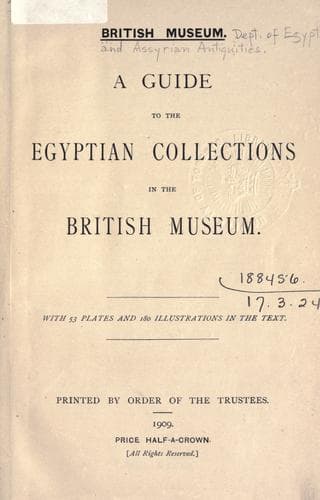
A guide to the Egyptian collections in the British MuseumBritish Museum. Department of Egyptian and Assyrian Antiquities
History
A guide to the Egyptian collections in the British Museum
British Museum. Department of Egyptian and Assyrian Antiquities
Egypt -- Antiquities
The funerary art of this period is well illustrated by the stelae and
“false doors” of: =Sennu= (Bay 1, No. =81=), =Ptaḥ-ḥetep=, a priest
(No. =82=), =Erṭā-en-ānkh=, a royal kinsman and councillor (No. =83=),
=Uthenȧa=, whose “good name” was Penȧ (a very interesting relief, No.
=84=), =Ȧṭu=, a scribe and superintendent of the “Great House of the
Six” (No. =85=), =Behenu=, a priestess of Hathor (No. =88=), and a
portion of a slab from the =roof= of =a tomb=, with flutings, which are
probably intended to represent tree trunks (No. =90=). All these, with
the exception of No. 81, are in the Egyptian Vestibule. To this period
also probably belong the =libation tanks=, and =tablet for offerings= of
=Ȧntḳes=, =Khart-en-Khennu=, and =Senb= (Bay 14, Nos. =93-95=).
Besides the larger remains of this period, the =scarabs= in the
Table-cases in the Fourth Egyptian Room should be examined. Several of
them are inscribed with names of the kings of the first six dynasties,
but it is not certain how many, or if any, of such scarabs are
contemporaneous, and for this reason they have not been described in
the preceding paragraphs. On the other hand, of the fine collection of
=scarabs of officials=, inscribed with their titles, scores certainly
belong to the period of the first half of the Ancient Empire, and are of
the greatest interest and historical value.
The monuments prove that between the IVth and VIth dynasties the
Egyptians lived in a state of serfdom, and that they regarded their king
as the owner of both their souls and bodies. He was the very essence of
God in human form upon earth, and his power was absolute; even in the
Other World his authority was held to be equal to that of the great gods
of the dead. The Pharaohs of this period were masters of the Peninsula of
Sinai, and of the Eastern Desert between Egypt and the Red Sea; and the
memory of the raid which Seneferu made in the Sûdân probably induced the
warlike tribes of that country to permit Egyptian caravans to pass from
Syene to the Blue and White Niles unmolested.
At the close of the VIth dynasty a period of general disorder appears to
have set in, the chiefs of cities such as Suten-ḥenen (Herakleopolis),
Asyûṭ and Thebes contending among themselves for supremacy. Of the
history of this period nothing is known. According to Manetho (version of
Africanus) we have:—
Seventh Dynasty. From Memphis.
Seventy kings in seventy days.
Eighth Dynasty. From Memphis.
Twenty-seven kings in 146 years.
The Tablet of Abydos supplies after Neter-ka-Rā, the name of the last
king of the VIth dynasty, the following sixteen names, which represent,
presumably, the kings of the VIIIth dynasty:—
Public-domain text, read in full here on John Shaqi.
Reviews
Reviews
No reviews yet
Be the first to share your thoughts on this work.
Elsewhere in the archive
Join the Discussion
Join the discussion
Sign in to leave a comment or review.
Sign InorCreate an account