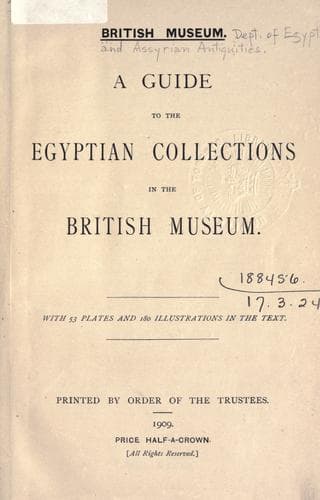
A guide to the Egyptian collections in the British MuseumBritish Museum. Department of Egyptian and Assyrian Antiquities
History
A guide to the Egyptian collections in the British Museum
British Museum. Department of Egyptian and Assyrian Antiquities
Egypt -- Antiquities
Pepi I was succeeded by =Mer-en-Rā I Tchefau(?)-em-sa-f=, who carried
on the works begun by his father, and built a pyramid at Ṣaḳḳârah,
from which came the fine alabaster vase in Wall-case 138 in the Fourth
Egyptian Room, No. 66. He was succeeded by =Nefer-ka-Rā Pepi II=, who
according to tradition lived to the age of 100 years. During his reign
Egypt was in a state of prosperity, and there was great activity in trade
and handicrafts. At this time flourished the famous official =Ḥer-Khuf=,
who was the master of a caravan which traded between Egypt and the Sûdân,
which country he visited four times. On the last occasion he brought
back a =pygmy= from “the land of the Spirits,” which King Pepi II bade
him bring to Memphis. Detailed orders were sent to the effect that the
pygmy was to be watched during the day so that he might not fall into the
water, and his sleeping place was to be visited ten times each night by
properly qualified people, for, said the king: “I wish to see him more
than all the tributes of Sinai and Punt.” Other prominent traders in the
Sûdân on behalf of the king at this time were Pepi-nekht, Mekhu, who died
there, and whose body was brought back to Egypt by his son Sabben, etc.
Among the objects of the time of Pepi II may be mentioned a =portion=
of a =doorway= made by him at Abydos, and a sepulchral stele of
=Nefer-Sennȧ=, from his tomb at Denderah (Egyptian Vestibule, Nos. =77=
and =78=). Among the priests who ministered in the chapel attached to
the pyramid of Pepi II was =Heb-peri=, whose stele is exhibited in the
Egyptian Vestibule, No. =79=. The most important monument of his reign
is the =maṣṭaba tomb= of =Ur-ȧri-en-Ptaḥ=, a royal kinsman and scribe,
libationer, and councillor, from Ṣaḳḳârah, which has been re-built in the
=Assyrian Saloon= (No. =80=). It is a good typical example of the tomb
of noblemen and high officials of the period. The painted reliefs are
interesting, and are typical of the wall decorations of tombs towards the
close of the VIth dynasty. The inscriptions show that both Ur-ȧri-en-Ptaḥ
and his wife were buried in the chamber beneath the maṣṭaba; the list of
offerings, some 90 in number, is exceptionally long.
Of the last king of the VIth dynasty, =Mer-en-Rā II Tchefa-em-sa-f=,
nothing is known.
Public-domain text, read in full here on John Shaqi.
Reviews
Reviews
No reviews yet
Be the first to share your thoughts on this work.
Elsewhere in the archive
Join the Discussion
Join the discussion
Sign in to leave a comment or review.
Sign InorCreate an account