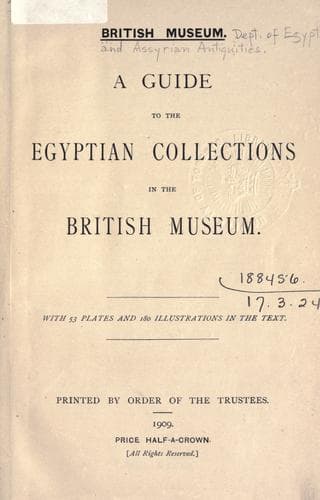
A guide to the Egyptian collections in the British MuseumBritish Museum. Department of Egyptian and Assyrian Antiquities
History
A guide to the Egyptian collections in the British Museum
British Museum. Department of Egyptian and Assyrian Antiquities
Egypt -- Antiquities
Among the monuments of his reign may be mentioned: A fine red granite
stele on which are sculptured figures of Khnemu and Sati, gods of the
First Cataract, and his Horus name, from Philae (Bay 5, No. =136=); head
of a colossal granite statue of Usertsen I, wearing the Crown of the
South (Bay 1, No. =137=); and a fragment of a chalcedony vase inscribed
with the king’s prenomen 𓍹𓇳𓆣𓂓𓍺 (No. 67, Wall-case 138, Fourth Egyptian
Room). Of his officials there are the painted stele of =Ȧthi=, who died
in the 14th year of the king’s reign (Bay 3, No. =138=); the stele of
=Neferu=, the overseer of the royal water-transport at Behen, or Wâdî
Ḥalfah (Bay 3, No. =139=), and two stelae and a statue of =Ȧntef=, the
son of Sebek-unnu and the lady Sent. Ȧntef was a confidential servant of
the king and superintended the royal private apartments in the palace; he
died four years before his master, _i.e._, in the 39th year of the reign
of Usertsen I. (See Bay 1, No. =140=; Bay 3, Nos. =141= and =142=.)
[Illustration: PLATE XXIV.
Sepulchral tablet and seated portrait figure of Sa-Hathor, a mining
inspector in the Sûdân, in the reign of Ȧmenemḥāt II, B.C. 2400.
[Southern Egyptian Gallery, Bay 1, No. 143.]]
[Sidenote: B.C. 2400.]
The reign of =Ȧmenemḥāt II= was prosperous, but uneventful; and no
military expeditions of importance were necessary either in the
Peninsula of Sinai or in Nubia. There was a large colony of Egyptians at
Sarâbît al-Khâdim, and a temple was built there in this reign to Hathor,
the goddess “of the land of the turquoise.” The search for gold was
carried on actively in the Sûdân, under the direction of =Sa-Hathor=,
who tells us on his stele (Bay 1, No. =143=; see =Plate XXIV=) that he
worked in the mining districts when he was a young man, and that he made
the chiefs wash out the gold; he brought back turquoises and went to the
=Land of the Blacks=, or Sûdân, and collected the products of the country
for his master. His knowledge of stone working induced the king to send
him to superintend the hewing of the ten royal statues which he placed
before his pyramid tomb. An interesting event of this period was the
despatch of an =expedition to Punt= under the direction of Khent-khat-ur,
who returned safely with his men in the 28th year of the king’s reign.
In the third year of Ȧmenemḥāt II died the Erpā =Sa-Menthu=, a royal
scribe and overseer of works. He was born in the reign of Ȧmenemḥāt I,
and was appointed scribe, etc., by Usertsen I. His sepulchral stele is
a fine example of its class (Bay 6, No. =145=). Another interesting
stele of this reign is that of =Khenti-em-semti=, a royal official, and
confidential servant and treasurer to the king; he visited Elephantine
and Abydos (Bay 1, No. =146=). The official =Khenti-em-semt-ur= was a
libationer priest who ministered in the chapel attached to the royal
pyramid called “Kherp” 𓌂𓉴𓊖𓏏𓏤 (Bay 1, No. =147=). The =door socket= (Bay
5, No.
Public-domain text, read in full here on John Shaqi.
Reviews
Reviews
No reviews yet
Be the first to share your thoughts on this work.
Elsewhere in the archive
Join the Discussion
Join the discussion
Sign in to leave a comment or review.
Sign InorCreate an account