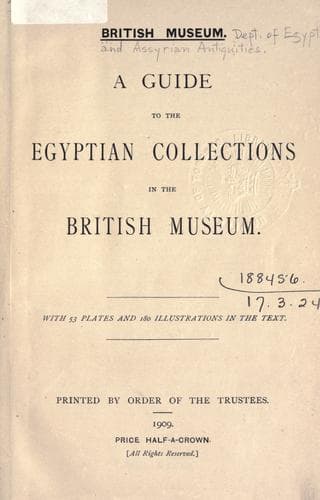
A guide to the Egyptian collections in the British MuseumBritish Museum. Department of Egyptian and Assyrian Antiquities
History
A guide to the Egyptian collections in the British Museum
British Museum. Department of Egyptian and Assyrian Antiquities
Egypt -- Antiquities
=Ȧmenemḥāt I=, the first king of the XIIth dynasty, appears to have
ascended the throne after a period of anarchy, and, even after his
accession, the members of his own household conspired against him.
The king tells us, in his =Instructions=, how one night, after he
had composed himself to sleep, a number of armed men burst into his
chamber and tried to murder him. Leaping from his couch he attacked his
assailants, and put them to flight. (See Sallier Papyri I and III, and
the slice of stone No. 41 in Table-case C in the Third Egyptian Room.)
Ȧmenemḥāt drew up a survey of the country, and set boundaries to each
nome, or province, and he framed a set of regulations for the supply of
water for irrigation to the different towns. Work went on in the quarries
of Ḥammâmât and Ṭura, and the king restored the temples at Tanis,
Bubastis, Abydos, etc., and founded a temple to Ȧmen at Karnak. He built
the fortified palace of Thet-taui 𓎁𓇾𓇾𓏏𓊖, near Memphis, and a pyramid
tomb called “Qā” 𓈎𓀠𓉴, at Lisht. He invaded the Sûdân, conquered the four
great tribes there, viz., the =Mātchaiu=, the =Uauaiu=, the =Satiu=, and
the =Ḥeriu-shā=, and made himself master of their country as far as the
modern Korosko or Ibrîm (Primis). His reign was prosperous, and in his
time “no man went hungry or thirsty.” He associated his son Usertsen I
with him in the rule of the kingdom in the 20th year of his reign.
[Sidenote: B.C. 2433.]
=Usertsen I= was a great builder, and he rebuilt, or re-founded, the
famous temple of Ȧnnu, the =On= of the Bible and the Heliopolis of
classical writers, the sanctuary of the =Bull= Mer-ur (=Mnevis=). Before
the temple he set up two obelisks, the pyramidions of which were cased
in copper; the one now standing is 65 feet high. He set up an obelisk
at Begig in the Fayyûm, and carried on the works of restoration of
the temples which his father had begun. In the 43rd year of his reign
he invaded Nubia, and compelled the tribes to pay him tribute, which
the official Ȧmeni collected and brought safely to Egypt. Ȧmeni was
despatched twice subsequently to Nubia to bring back =gold= and other
products of the Sûdân. The name given to Nubia in the inscription which
records these facts is =Kash= 𓎡𓄿𓈚𓈉, hence the Biblical =Cush=, which
does not, however, mean Ethiopia in the modern sense of the term, but
Nubia. Usertsen I built a fort and a temple at Behen, the modern Wâdî
Ḥalfah, and appointed a “Governor of the South” to rule over Nubia,
or the Northern Sûdân. The old copper mines in the Wâdî Maghârah were
reopened, and new ones at Ṣarâbît al-Khâdim were also worked; the king
built his pyramid tomb at Lisht, and associated his son with him in the
rule of the kingdom a year before he died.
Public-domain text, read in full here on John Shaqi.
Reviews
Reviews
No reviews yet
Be the first to share your thoughts on this work.
Elsewhere in the archive
Join the Discussion
Join the discussion
Sign in to leave a comment or review.
Sign InorCreate an account