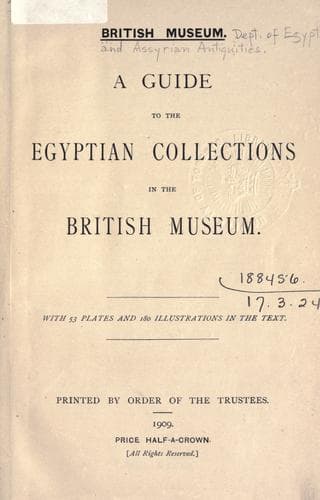
A guide to the Egyptian collections in the British MuseumBritish Museum. Department of Egyptian and Assyrian Antiquities
History
A guide to the Egyptian collections in the British Museum
British Museum. Department of Egyptian and Assyrian Antiquities
Egypt -- Antiquities
=Usertsen III=, who was associated with his father in the rule of the
kingdom, was probably the greatest king of the XIIth dynasty. The
principal events of his reign were the conquest and occupation of all
the Northern Sûdân. As a preparation for this work, he made, or cleared
out, a canal about 250 feet long, 34½ feet wide, and 26 feet deep, in
the First Cataract, so that he might pass boats through it to the south.
In the 8th year of his reign he sailed up to Wâdî Ḥalfah, and, passing
on to one of the great “Gates” in the Second Cataract, he built two
forts, one on each bank, at the places now called Semnah (west bank) and
Kummah (east bank). He also built a fort to the north, on the Island
Gazîrat al-Malik, and others probably on the islands in the Nile to the
south. In fact, he occupied the whole of the gold-producing country of
the Northern Sûdân. He set up a stele at Semnah to mark the limit of
his kingdom on the south, and caused to be inscribed on it a decree
in which the Blacks were prohibited from entering Egyptian territory
without permission. Eight years later he set up two inscribed stelae in
which he vaunted his own boldness, prompt action, and invincibility,
and abused the Blacks, calling them cowards, runaways, etc. He says:
“I have seen them, I made no mistake about them. I seized their women,
I carried off their men and women when I came to their wells, I slew
their bulls, I destroyed their grain, and set fire [to their houses].”
Usertsen III established a line of forts at regular intervals along the
River Nile between Elephantine and the famous rock called Gebel Dôsha,
and garrisoned them with Egyptian troops; and was thus able to ensure the
safe transport of gold into Egypt, where the precious metal was required
in ever-increasing quantities. He repaired and added to many of the great
temples of Egypt, _e.g._, Tanis, Bubastis, Abydos, Herakleopolis, Thebes,
Elephantine, etc., and he built a pyramid tomb for himself at Dahshûr.
Among the monuments of this king and his reign may be mentioned: Three
grey granite =statues of Usertsen III= (Nos. =158=, =159=, =160=) which
were found in the South Court of the temple of Neb-ḥap-Rā Menthu-ḥetep
at Dêr al-Baḥarî. These fine statues appear to represent the king at
different periods of his life, and in finish and execution they stand
unrivalled among the monuments of the period. On the plinth of No. =158=
(Bay 1) are cut the king’s Horus name =Neter Kheperu=, and his name as
king of the South and North (see above, page 116) 𓍹𓇳𓈍𓂓𓂓𓂓𓍺 (see =Plate
XXV=). Head of a colossal granite statue of Usertsen III (Bay 1, No.
=161=); a portion of a seated figure of the king from Ṣarâbît al-Khâdim
(Bay 1, No. =162=); and the lower portions of two quartzite statues of
the king (Vestibule, Nos. =163=, =164=). No. 164 was usurped by Uasarken
II, of the XXIInd dynasty, who cut his cartouches upon the pedestal. The
building activity of the king at Bubastis is marked by the granite slabs
Public-domain text, read in full here on John Shaqi.
Reviews
Reviews
No reviews yet
Be the first to share your thoughts on this work.
Elsewhere in the archive
Join the Discussion
Join the discussion
Sign in to leave a comment or review.
Sign InorCreate an account