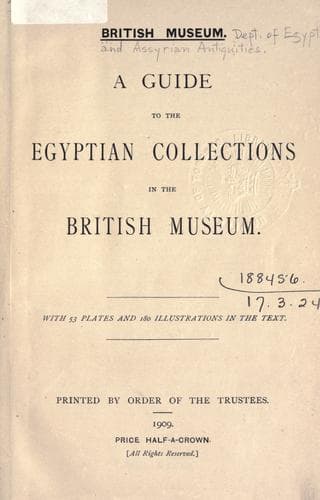
A guide to the Egyptian collections in the British MuseumBritish Museum. Department of Egyptian and Assyrian Antiquities
History
A guide to the Egyptian collections in the British Museum
British Museum. Department of Egyptian and Assyrian Antiquities
Egypt -- Antiquities
from that site in Bay 23 (Nos. =166= and =167=) on which is cut the royal
prenomen. No. 167 is of interest, for here we see part of the prenomen
of Rameses II cut over that of Usertsen III. Of the prominent officials
who flourished in this reign we have the stele of =Ȧn-ḥer-nekht=, the
=overseer of the granaries=, dated in the 7th year (Bay 1, No. =168=);
the stele of =Ȧmeni=, who carried out certain works at Elephantine in
connexion with the king’s expedition into Nubia, dated in the 8th year
(Bay 3, No. =169=); and the stele of =Sebek-ḥetep=, a warder of a temple,
dated in the 13th year (Bay 5, No. =170=).
[Illustration: PLATE XXV.
Granite statue of Usertsen III, B.C. 2330.
XIIth dynasty.
[Northern Egyptian Gallery, Bay 1, No. 159.]]
[Sidenote: B.C. 2300.]
=Ȧmenemḥāt III= reigned about fifty years, and devoted all his energies
to improving the prosperity of his kingdom. Art, sculpture, architecture,
and trade of all kinds flourished under his fostering care; and the
remains of his buildings and inscribed monuments bear witness to the
activity which must have prevailed among all classes of handicraftsmen
during his reign. The mines of Sinai, the Wâdî Ḥammâmât, Ṭura, and
elsewhere were diligently worked, and the king carried out large
irrigation works in connexion with the great =natural reservoir= in
the Fayyûm, which is commonly known by the name of =Lake Moeris= (from
the Egyptian Mu-ur, or Ma-ur) 𓈗𓅨𓂋, 𓈘𓅨𓂋𓈗. The circumference of this
reservoir was 150 miles, and its area 750 square miles; its average level
was 80 feet above the Mediterranean. In Nubia also he appears to have
undertaken irrigation works, for several “levels” are cut on the rocks
near the Forts of Usertsen III at Semnah and Kummah, with the years of
the king’s reign in which they were cut. They show that the level of
the river during the inundation was about 26 feet higher than it is
at the present time. Ȧmenemḥāt III is also thought to have built the
=Labyrinth=, which Herodotus says (ii, 148) contained twelve courts, and
3,000 chambers, 1,500 above ground and 1,500 under ground, and covered an
area about 1,000 feet long and 800 feet broad. It was dedicated to the
crocodile-god Sebek; and many sacred crocodiles were buried in a place
specially set apart for them. Ȧmenemḥāt III built a pyramid at Ḥawârah,
and he and his daughter Ptaḥ-Nefert were buried in it. From the ruins
of the chapel at the entrance to this pyramid came the limestone slab
inscribed with the king’s names and titles exhibited in Bay 5 (No. =171=).
Public-domain text, read in full here on John Shaqi.
Reviews
Reviews
No reviews yet
Be the first to share your thoughts on this work.
Elsewhere in the archive
Join the Discussion
Join the discussion
Sign in to leave a comment or review.
Sign InorCreate an account